<?xml version="1.0" encoding="UTF-8"?><feed
	xmlns="http://www.w3.org/2005/Atom"
	xmlns:thr="http://purl.org/syndication/thread/1.0"
	xml:lang="sv-SE"
	>
	<title type="text">Bullish</title>
	<subtitle type="text"></subtitle>

	<updated>2026-08-22T23:34:50Z</updated>

	<link rel="alternate" type="text/html" href="https://bullish.se" />
	<id>https://bullish.se/feed/atom/</id>
	<link rel="self" type="application/atom+xml" href="https://bullish.se/feed/atom/" />

	<generator uri="https://wordpress.org/" version="7.1">WordPress</generator>
	<entry>
		<author>
			<name>Bullish</name>
							<uri>https://bullish.se</uri>
						</author>

		<title type="html"><![CDATA[Hexagon Just Proved Its Breakup Strategy Works &#8211; Now Comes the Hard Part]]></title>
		<link rel="alternate" type="text/html" href="https://bullish.se/2026/08/25/hexagon-just-proved-its-breakup-strategy-works-now-comes-the-hard-part/" />

		<id>https://bullish.se/?p=2165</id>
		<updated>2026-08-08T21:47:15Z</updated>
		<published>2026-08-25T06:00:00Z</published>
		<category scheme="https://bullish.se" term="Company Deep-Dive" /><category scheme="https://bullish.se" term="Hexagon" />
		<summary type="html"><![CDATA[Hexagon builds and sells the sensors, software, and positioning systems that let factories, construction sites, and autonomous machines know exactly where things are &#8211; down to the millimeter. I'd call this a hold, not a chase &#8211; the stock already ran 12 percent on report day and most of the sell-side price targets that came out the next morning cluster right around where it's trading now.]]></summary>

					<content type="html" xml:base="https://bullish.se/2026/08/25/hexagon-just-proved-its-breakup-strategy-works-now-comes-the-hard-part/"><![CDATA[
<p class="wp-block-paragraph">Hexagon just spent five months tearing itself apart on purpose.</p>


<p class="wp-block-paragraph">It sold its Design &amp; Engineering business to Cadence for roughly €2.7 billion.</p>


<p class="wp-block-paragraph">It spun off an entire division, Octave, and handed it to shareholders as a separately listed company. </p>


<p class="wp-block-paragraph">And then, in the same stretch, it went out and bought a non-destructive testing business, Waygate Technologies, to bolt onto what was left. </p>



<figure data-wp-context="{&quot;imageId&quot;:&quot;6a960c321e0d5&quot;}" data-wp-interactive="core/image" data-wp-key="6a960c321e0d5" class="wp-block-image size-large wp-lightbox-container"><img fetchpriority="high" decoding="async" width="1024" height="576" data-wp-class--hide="state.isContentHidden" data-wp-class--show="state.isContentVisible" data-wp-init="callbacks.setButtonStyles" data-wp-on--click="actions.showLightbox" data-wp-on--load="callbacks.setButtonStyles" data-wp-on--pointerdown="actions.preloadImage" data-wp-on--pointerenter="actions.preloadImageWithDelay" data-wp-on--pointerleave="actions.cancelPreload" data-wp-on-window--resize="callbacks.setButtonStyles" src="https://bullish.se/wp-content/uploads/2026/08/IMG_1421-1024x576.jpeg" alt="" class="wp-image-2439" srcset="https://bullish.se/wp-content/uploads/2026/08/IMG_1421-1024x576.jpeg 1024w, https://bullish.se/wp-content/uploads/2026/08/IMG_1421-300x169.jpeg 300w, https://bullish.se/wp-content/uploads/2026/08/IMG_1421-768x432.jpeg 768w, https://bullish.se/wp-content/uploads/2026/08/IMG_1421-1536x864.jpeg 1536w, https://bullish.se/wp-content/uploads/2026/08/IMG_1421-1200x675.jpeg 1200w, https://bullish.se/wp-content/uploads/2026/08/IMG_1421.jpeg 1920w" sizes="(max-width: 1024px) 100vw, 1024px" /><button
			class="lightbox-trigger"
			type="button"
			aria-haspopup="dialog"
			data-wp-bind--aria-label="state.thisImage.triggerButtonAriaLabel"
			data-wp-init="callbacks.initTriggerButton"
			data-wp-on--click="actions.showLightbox"
			data-wp-style--right="state.thisImage.buttonRight"
			data-wp-style--top="state.thisImage.buttonTop"
		>
			<svg xmlns="http://www.w3.org/2000/svg" width="12" height="12" fill="none" viewBox="0 0 12 12">
				<path fill="#fff" d="M2 0a2 2 0 0 0-2 2v2h1.5V2a.5.5 0 0 1 .5-.5h2V0H2Zm2 10.5H2a.5.5 0 0 1-.5-.5V8H0v2a2 2 0 0 0 2 2h2v-1.5ZM8 12v-1.5h2a.5.5 0 0 0 .5-.5V8H12v2a2 2 0 0 1-2 2H8Zm2-12a2 2 0 0 1 2 2v2h-1.5V2a.5.5 0 0 0-.5-.5H8V0h2Z" />
			</svg>
		</button><figcaption class="wp-element-caption">Photo: Hexagon</figcaption></figure>


<p class="wp-block-paragraph">That&#8217;s an unusual amount of surgery for one half-year.</p>


<p class="wp-block-paragraph">The interesting part isn&#8217;t that Hexagon did it – plenty of conglomerates decide to focus. The interesting part is that the first quarter reported under the new, smaller structure came in stronger than almost anything the old, bigger structure produced in years. </p>


<p class="wp-block-paragraph">That&#8217;s the kind of coincidence worth interrogating rather than just applauding.</p>


<div class="post-summary bg-gray-100 dark:bg-gray-800 border border-gray-200 dark:border-gray-700 max-w-xl mx-auto p-4 pb-2 rounded-tl rounded-tr">
    <h5 class="wp-block-heading font-jetbrains !text-gray-900 dark:!text-gray-200">TL;DR</h5>
    <div class="summary-content text-gray-900 dark:text-gray-200">
        <ul class="list-disc pl-4 text-left marker:text-gray-900 dark:marker:text-gray-200">
            <li class="font-serif text-sm text-gray-900 dark:text-gray-200">Hexagon builds and sells the sensors, software, and positioning systems that let factories, construction sites, and autonomous machines know exactly where things are – down to the millimeter.</li><li class="font-serif text-sm text-gray-900 dark:text-gray-200">Q2 2026 was the strongest organic growth quarter in five years, and it landed just months after the company spun off Octave and sold its Design &amp; Engineering unit – the market got proof, not just a promise, that the leaner Hexagon works.</li><li class="font-serif text-sm text-gray-900 dark:text-gray-200">The real risk isn&#8217;t the quarter itself, it&#8217;s whether 12 percent organic growth is a new baseline or a sugar high from tariff-related restocking that doesn&#8217;t repeat in Q3.</li><li class="font-serif text-sm text-gray-900 dark:text-gray-200">Margins told the more durable story: EBITAC margin ex-Robotics hit 24.3 percent, up 200 basis points, with roughly two-thirds of that gain coming from operating leverage on the growth rather than one-off items.I&#8217;d call this a hold, not a chase – the stock already ran 12 percent on report day and most of the sell-side price targets that came out the next morning cluster right around where it&#8217;s trading now.</li>        </ul>
    </div>
</div>
<div class="expand-button-content bg-gray-100 dark:bg-gray-800 border border-t-0 border-gray-200 dark:border-gray-700 max-w-xl mb-8 mx-auto rounded-bl rounded-br text-center">
    <button class="expand-button">
        <span class="button-text font-jetbrains uppercase">Show more</span>
        <span class="arrow">&#x2193;</span>
    </button>
</div>


<h3 class="wp-block-heading">The Short Version</h3>


<p class="wp-block-paragraph">Hexagon is a Swedish industrial technology company that makes the sensors, software, and positioning systems used to measure and navigate the physical world – everything from coordinate measuring machines on a factory floor to GNSS receivers that keep autonomous tractors in a straight line. </p>


<p class="wp-block-paragraph">Market cap sits around SEK 250 billion (roughly €22.5 billion) after a sharp post-earnings rally.</p>


<p class="wp-block-paragraph">For readers outside Sweden: this is the kind of company Stockholm produces a lot of – precision industrial technology, family-anchored ownership through Melker Schörling AB, decades of bolt-on acquisitions – but with genuinely global end markets and very little that&#8217;s parochial about the business itself.</p>


<h3 class="wp-block-heading">What Hexagon Actually Sells, and to Whom</h3>


<p class="wp-block-paragraph">Strip away the segment names and Hexagon has three ways of making money.</p>


<p class="wp-block-paragraph">Manufacturing Intelligence sells measurement hardware and software to factories – coordinate measuring machines, laser trackers, production software – to aerospace, electronics, and general manufacturing customers who need to verify that what they built matches what they designed, often to tolerances measured in microns.</p>


<p class="wp-block-paragraph">Infrastructure &amp; Geospatial sells the equivalent toolkit to construction and surveying – laser scanners, machine control systems for excavators, mapping software. </p>


<p class="wp-block-paragraph">Autonomous Solutions is the newest and fastest-growing leg: GNSS positioning modules and correction services that go into mining equipment, agricultural machinery, and increasingly defense applications, through brands like NovAtel and Septentrio.</p>


<p class="wp-block-paragraph">The common thread across all three is that customers aren&#8217;t buying a one-off box.</p>


<p class="wp-block-paragraph">A coordinate measuring machine gets embedded into a factory&#8217;s quality control workflow; a GNSS module gets designed into another company&#8217;s product for years. </p>


<p class="wp-block-paragraph">That creates real switching costs, and it&#8217;s a large part of why 26 percent of Q2 revenue was recurring – subscription software, maintenance, and consumables that don&#8217;t evaporate when a single hardware refresh cycle slows down.</p>


<p class="wp-block-paragraph">The growth strategy right now is explicitly acquisitive rather than purely organic.</p>


<p class="wp-block-paragraph">Waygate, announced in the quarter, pushes Hexagon into non-destructive testing – inspecting welds and castings without damaging them – which sits adjacent to existing metrology customers in aerospace and energy. </p>


<p class="wp-block-paragraph">Management framed it as expanding the addressable market rather than diversifying away from it, and at roughly $630 million of 2025 revenue with a 10 percent operating margin, it&#8217;s a bolt-on, not a bet-the-company deal. </p>


<p class="wp-block-paragraph">Two smaller acquisitions, Inertial Sense and ITRES Research, filled out the positioning and mapping portfolio further.</p>


<p class="wp-block-paragraph">None of this is exotic.</p>


<p class="wp-block-paragraph">It&#8217;s the same playbook Hexagon has run for two decades – buy adjacent capability, sell it through the same channel.</p>


<h3 class="wp-block-heading">The Numbers That Actually Moved Me</h3>


<p class="wp-block-paragraph">Twelve percent organic growth is the headline, and it&#8217;s real – the highest Hexagon has posted in five years, and unusually broad: Autonomous Solutions grew 20 percent, Manufacturing Intelligence 13 percent, and even Infrastructure &amp; Geospatial, which is fighting a genuinely weak European construction market, still managed 4 percent.</p>


<p class="wp-block-paragraph">When your weakest segment is still growing, the story isn&#8217;t one lucky division.</p>


<p class="wp-block-paragraph">But growth alone doesn&#8217;t tell you whether a restructuring worked – margin does, because margin is where operating leverage either shows up or doesn&#8217;t.</p>


<p class="wp-block-paragraph">EBITAC margin excluding Robotics came in at 24.3 percent, up from 22.3 percent a year earlier.</p>


<p class="wp-block-paragraph">Strip out the divested D&amp;E business from last year&#8217;s comparison and the underlying improvement was closer to 330 basis points, of which management attributed about 230 basis points to organic growth flowing through with early benefits from its cost restructuring program, and the rest to currency.</p>


<p class="wp-block-paragraph">That&#8217;s a genuinely useful split, because it tells you how much of the margin gain is structural versus a tailwind that can reverse.</p>


<p class="wp-block-paragraph">Cash conversion is the number I watch most closely, because it&#8217;s the hardest one to fake.</p>


<p class="wp-block-paragraph">It came in at 149 percent of EBITAC in the quarter, up from 124 percent, even while hardware sales – which typically eat working capital – were rising sharply. </p>


<p class="wp-block-paragraph">Net debt fell to just 0.09x EBITDA. </p>


<p class="wp-block-paragraph">Some of that improvement is mechanical, a function of the D&amp;E and Octave proceeds flowing through the balance sheet rather than pure operating cash generation, but it leaves Hexagon with enough dry powder to keep doing bolt-ons like Waygate without stretching the balance sheet.</p>


<figure class="wp-block-table"><table><thead><tr><th>Metric</th><th>Value</th><th>Context</th></tr></thead><thead><tr><td>Organic growth (Q2 2026)</td><td>12%</td><td>Vs. 3% a year ago – highest in five years, positive across all three segments</td></tr></thead><tbody><tr><td>EBITAC margin ex-Robotics</td><td>24.3%</td><td>Up from 22.3%; ~230bps of the like-for-like gain came from operating leverage, not currency</td></tr><tr><td>Cash conversion</td><td>149%</td><td>Up from 124%, despite rising hardware sales that typically eat working capital</td></tr><tr><td>Net debt / EBITDA</td><td>0.09x</td><td>Down from 0.39x – mostly D&amp;E and Octave proceeds, but leaves room for further bolt-ons</td></tr><tr><td>Adjusted EPS</td><td>€0.078</td><td>Up from €0.069; beat consensus (~€0.072) by enough to move 2026 estimates</td></tr></tbody></table></figure>


<h3 class="wp-block-heading">What the Chart Is Actually Showing</h3>


<p class="wp-block-paragraph">The stock jumped roughly 12 percent on report day, against a Stockholm large-cap index that barely moved. </p>


<div class="wp-block-bullish-tracker-tradingview-ticker">
    <tv-single-ticker symbol="OMXSTO:HEXA_B"></tv-single-ticker>
</div>


<p class="wp-block-paragraph">That&#8217;s not a drift-up on relief – it&#8217;s a repricing.</p>


<p class="wp-block-paragraph">Sell-side desks moved fast: SEB lifted its target to SEK 100 from 93, Citigroup to SEK 95 from 82, JP Morgan to SEK 90 from 85, all within 24 hours of the print. </p>


<p class="wp-block-paragraph">What that tells me is less about where the stock goes next and more about how low expectations had drifted after a multi-year stretch of declining return on capital employed – from 13 percent in 2021 down to 10 percent in 2025. </p>


<p class="wp-block-paragraph">A one-quarter rebound doesn&#8217;t erase four years of a falling trend on its own, but it&#8217;s the first data point that argues the trend has actually turned rather than just paused.</p>


<h3 class="wp-block-heading">What the Market Might Be Missing – or Might Not Be</h3>


<p class="wp-block-paragraph">The consensus read on Hexagon right now is straightforward: the breakup worked, buy the execution.</p>


<p class="wp-block-paragraph">I don&#8217;t think that&#8217;s wrong, but I think it&#8217;s under-pricing one variable – how much of the 12 percent came from tariff-related catch-up spending in manufacturing that isn&#8217;t a recurring driver.</p>


<p class="wp-block-paragraph">Management acknowledged as much in its own commentary about demand patterns.</p>


<p class="wp-block-paragraph">If a meaningful chunk of this quarter&#8217;s strength was customers front-loading orders ahead of anticipated tariff costs, Q3&#8217;s comparison gets harder, not easier, and a market that just re-rated the stock on the assumption of a new higher-growth baseline could find itself disappointed by a perfectly respectable but merely high-single-digit number.</p>


<h3 class="wp-block-heading">The Risks I&#8217;d Actually Worry About</h3>


<p class="wp-block-paragraph">First, the growth durability question above – if organic growth drops back toward 6-8 percent in Q3, the stock&#8217;s one-day re-rating looks premature, not wrong, but early.</p>


<p class="wp-block-paragraph">Second, Waygate integration risk: Hexagon is absorbing a $630 million acquisition into a business that just went through two other structural transactions in the same six months, and integration bandwidth is finite even at a company with Hexagon&#8217;s M&amp;A track record.</p>


<p class="wp-block-paragraph">Third, Robotics remains a cash drag with no committed timeline to profitability – €10.5 million invested in the quarter alone, explicitly excluded from the group&#8217;s own margin targets because management doesn&#8217;t think it&#8217;s fair to judge it on the same terms yet.</p>


<p class="wp-block-paragraph">That&#8217;s honest framing, but it also means the market is being asked to underwrite a call option with no visible strike price.</p>


<h3 class="wp-block-heading">Where I Land</h3>


<p class="wp-block-paragraph">I think the restructuring thesis is validated, not proven.</p>


<p class="wp-block-paragraph">One quarter of 12 percent organic growth after two divestitures and one large acquisition is a genuinely strong data point, and the margin math behind it – roughly two-thirds structural, one-third currency – is more convincing than the headline number alone. </p>


<p class="wp-block-paragraph">But the stock already moved to reflect that. </p>


<p class="wp-block-paragraph">For the thesis to earn a higher price from here, I&#8217;d want to see three specific things: organic growth holding in mid-to-high single digits even as the tariff-related tailwind fades, EBITAC margin continuing to close the gap toward the new 24-26 percent target range management set at its April capital markets day, and Waygate integrating without a visible drag on Manufacturing Intelligence margins when it closes in H2.</p>


<p class="wp-block-paragraph">This is a name for the investor who wants exposure to a genuine industrial-technology quality compounder mid-turnaround, with a controlling family shareholder and a balance sheet clean enough to keep doing accretive bolt-ons. </p>


<p class="wp-block-paragraph">It&#8217;s the wrong stock if you&#8217;re looking for a re-rating catalyst that hasn&#8217;t already happened – the easy part of this story, the one-day surprise, is behind it, and what&#8217;s left is the harder job of proving Q2 wasn&#8217;t the peak.</p>


<figure class="wp-block-table"><table><thead><tr><th>Field</th><th>Value</th></tr></thead><thead><tr><td>Stock(s)</td><td>Hexagon B</td></tr></thead><tbody><tr><td>Ticker</td><td>HEXA B.ST</td></tr><tr><td>Exchange / List</td><td>Nasdaq Stockholm, Large Cap (OMXS30)</td></tr><tr><td>Sector</td><td>Industrial Technology / Precision Measurement</td></tr><tr><td>Share price</td><td>≈SEK 94 (July 29, 2026 close)</td></tr><tr><td>Market cap</td><td>≈SEK 250bn (≈€22.5bn)</td></tr><tr><td>Dividend</td><td>Yes – €0.14/share proposed for FY2025 (yield ≈1.6%)</td></tr><tr><td>Next report</td><td>October 23, 2026 (Q3 2026)</td></tr></tbody></table></figure>
]]></content>
		
			</entry>
		<entry>
		<author>
			<name>Bullish</name>
							<uri>https://bullish.se</uri>
						</author>

		<title type="html"><![CDATA[Dino Polska H1 – a Headline Beat Masks a Stalling Core Business]]></title>
		<link rel="alternate" type="text/html" href="https://bullish.se/brief/2026/08/23/dino-polska-h1-a-headline-beat-masks-a-stalling-core-business/" />

		<id>https://bullish.se/brief/2026/08/23//</id>
		<updated>2026-08-22T23:34:50Z</updated>
		<published>2026-08-23T06:00:00Z</published>
		<category scheme="https://bullish.se" term="Earnings Update" /><category scheme="https://bullish.se" term="Dino Polska" /><category scheme="https://bullish.se" term="H1 2026" />
		<summary type="html"><![CDATA[Dino Polska's Q2 2026 net profit topped consensus, but like-for-like sales growth nearly stalled at just 0.3 percent and EBITDA margin kept falling.]]></summary>

					<content type="html" xml:base="https://bullish.se/brief/2026/08/23/dino-polska-h1-a-headline-beat-masks-a-stalling-core-business/"><![CDATA[
<p class="wp-block-paragraph">Dino Polska, the Polish discount-format supermarket chain, published its first-half 2026 report on Thursday. </p>


<div class="wp-block-bullish-tracker-tradingview-ticker">
    <tv-single-ticker symbol="GPW:DNP"></tv-single-ticker>
</div>


<p class="wp-block-paragraph">Second-quarter net profit of PLN 400.1 million topped the PAP Biznes consensus of PLN 391.8 million, and EBITDA came in essentially in line. </p>


<p class="wp-block-paragraph">Revenue grew 10.5 percent year-on-year to PLN 9.53 billion, a touch below the PLN 9.56 billion analysts had penciled in. On paper, a clean, unremarkable print.</p>


<figure class="wp-block-table"><table><thead><tr><th></th><th>Consensus est. (PAP Biznes)</th><th>Actual Q2 2026</th><th>Beat/Miss</th></tr></thead><thead><tr><td>Revenue (Q2 2026)</td><td>PLN 9,557m</td><td>PLN 9,531m</td><td>Miss (-0.3%)</td></tr></thead><tbody><tr><td>EBIT (Q2 2026)</td><td>PLN 513m</td><td>PLN 511m</td><td>Miss (-0.4%)</td></tr><tr><td>EPS (Q2 2026)*</td><td>~PLN 0.40</td><td>PLN 0.41</td><td>Beat (+2%)</td></tr></tbody></table></figure>


<p class="wp-block-paragraph"><em>* EPS consensus derived from PAP Biznes’ net profit estimate of PLN 391.8m; not independently published as a per-share figure.</em></p>


<p class="wp-block-paragraph">The number that actually matters sits below the headline: like-for-like sales growth (LFL, sales growth from stores open more than a year) cratered to just 0.3 percent in the second quarter alone, down from 8.8 percent a year earlier and from 4.4 percent as recently as the first quarter. EBITDA margin (earnings before interest, tax, depreciation and amortization, as a share of revenue) kept falling too, to 6.98 percent from 7.54 percent. </p>


<p class="wp-block-paragraph">For context, Biedronka — Dino’s much larger domestic rival — improved its own EBITDA margin by roughly 42 basis points in the same quarter. Dino is still opening stores at pace, but the core business is barely growing organically right now.</p>


<p class="wp-block-paragraph">What strikes me is that the stock rose about 7,7 percent on a quarter this weak, which tells me expectations had already been reset lower than the headline numbers suggest — this reads more like relief than vindication. </p>


<p class="wp-block-paragraph">There’s also a new, unpriced risk here: Poland’s competition authority opened an antitrust probe into Dino’s trucking arrangements in June, with a maximum fine of 10 percent of last year’s sales. </p>


<p class="wp-block-paragraph">The next real test is Q3, when analysts expect the margin trend to start turning.</p>
]]></content>
		
			</entry>
		<entry>
		<author>
			<name>Bullish</name>
							<uri>https://bullish.se</uri>
						</author>

		<title type="html"><![CDATA[Spotify&#8217;s Margin Story Just Got Harder to Ignore]]></title>
		<link rel="alternate" type="text/html" href="https://bullish.se/2026/08/22/spotifys-margin-story-just-got-harder-to-ignore/" />

		<id>https://bullish.se/?p=2404</id>
		<updated>2026-08-08T11:12:45Z</updated>
		<published>2026-08-22T06:00:00Z</published>
		<category scheme="https://bullish.se" term="Company Deep-Dive" /><category scheme="https://bullish.se" term="margins" /><category scheme="https://bullish.se" term="SPOT" /><category scheme="https://bullish.se" term="Spotify" /><category scheme="https://bullish.se" term="streaming" />
		<summary type="html"><![CDATA[Spotify is the freemium audio marketplace that finally figured out how to convert scale into cash, not just users. My take: this is a buy, but not a screaming one &#8212; the operating story has clearly turned, yet the stock's valuation already assumes several more years of exactly this kind of execution.]]></summary>

					<content type="html" xml:base="https://bullish.se/2026/08/22/spotifys-margin-story-just-got-harder-to-ignore/"><![CDATA[
<p class="wp-block-paragraph">Every subscription business eventually has to answer an uncomfortable question: is the growth story actually a margin story wearing a disguise? </p>


<p class="wp-block-paragraph">Spotify spent the better part of two decades letting investors debate whether it could ever be genuinely profitable. That debate is now effectively over, and most of the commentary since the second-quarter print has focused on the wrong headline number.</p>


<figure data-wp-context="{&quot;imageId&quot;:&quot;6a960c3225e89&quot;}" data-wp-interactive="core/image" data-wp-key="6a960c3225e89" class="wp-block-image size-large wp-lightbox-container"><img decoding="async" width="1024" height="576" data-wp-class--hide="state.isContentHidden" data-wp-class--show="state.isContentVisible" data-wp-init="callbacks.setButtonStyles" data-wp-on--click="actions.showLightbox" data-wp-on--load="callbacks.setButtonStyles" data-wp-on--pointerdown="actions.preloadImage" data-wp-on--pointerenter="actions.preloadImageWithDelay" data-wp-on--pointerleave="actions.cancelPreload" data-wp-on-window--resize="callbacks.setButtonStyles" src="https://bullish.se/wp-content/uploads/2026/08/Newsroom-Press-image-1920x1080-Phone-pattern-2023-1024x576.png" alt="" class="wp-image-2398" srcset="https://bullish.se/wp-content/uploads/2026/08/Newsroom-Press-image-1920x1080-Phone-pattern-2023-1024x576.png 1024w, https://bullish.se/wp-content/uploads/2026/08/Newsroom-Press-image-1920x1080-Phone-pattern-2023-300x169.png 300w, https://bullish.se/wp-content/uploads/2026/08/Newsroom-Press-image-1920x1080-Phone-pattern-2023-768x432.png 768w, https://bullish.se/wp-content/uploads/2026/08/Newsroom-Press-image-1920x1080-Phone-pattern-2023-1536x864.png 1536w, https://bullish.se/wp-content/uploads/2026/08/Newsroom-Press-image-1920x1080-Phone-pattern-2023-1200x675.png 1200w, https://bullish.se/wp-content/uploads/2026/08/Newsroom-Press-image-1920x1080-Phone-pattern-2023.png 1920w" sizes="(max-width: 1024px) 100vw, 1024px" /><button
			class="lightbox-trigger"
			type="button"
			aria-haspopup="dialog"
			data-wp-bind--aria-label="state.thisImage.triggerButtonAriaLabel"
			data-wp-init="callbacks.initTriggerButton"
			data-wp-on--click="actions.showLightbox"
			data-wp-style--right="state.thisImage.buttonRight"
			data-wp-style--top="state.thisImage.buttonTop"
		>
			<svg xmlns="http://www.w3.org/2000/svg" width="12" height="12" fill="none" viewBox="0 0 12 12">
				<path fill="#fff" d="M2 0a2 2 0 0 0-2 2v2h1.5V2a.5.5 0 0 1 .5-.5h2V0H2Zm2 10.5H2a.5.5 0 0 1-.5-.5V8H0v2a2 2 0 0 0 2 2h2v-1.5ZM8 12v-1.5h2a.5.5 0 0 0 .5-.5V8H12v2a2 2 0 0 1-2 2H8Zm2-12a2 2 0 0 1 2 2v2h-1.5V2a.5.5 0 0 0-.5-.5H8V0h2Z" />
			</svg>
		</button><figcaption class="wp-element-caption">Photo: Spotify</figcaption></figure>


<p class="wp-block-paragraph">The 300 million Premium subscriber milestone got the attention. The number that should have gotten more of it is 33.4 percent — Spotify&#8217;s gross margin in the quarter, a record, and the sixth straight quarter of expansion. </p>


<p class="wp-block-paragraph">Reaching 300 million subscribers is a nice round number for a press release. Six consecutive quarters of margin expansion is a pattern, and patterns are what separate a story from a thesis.</p>


<div class="post-summary bg-gray-100 dark:bg-gray-800 border border-gray-200 dark:border-gray-700 max-w-xl mx-auto p-4 pb-2 rounded-tl rounded-tr">
    <h5 class="wp-block-heading font-jetbrains !text-gray-900 dark:!text-gray-200">TL;DR</h5>
    <div class="summary-content text-gray-900 dark:text-gray-200">
        <ul class="list-disc pl-4 text-left marker:text-gray-900 dark:marker:text-gray-200">
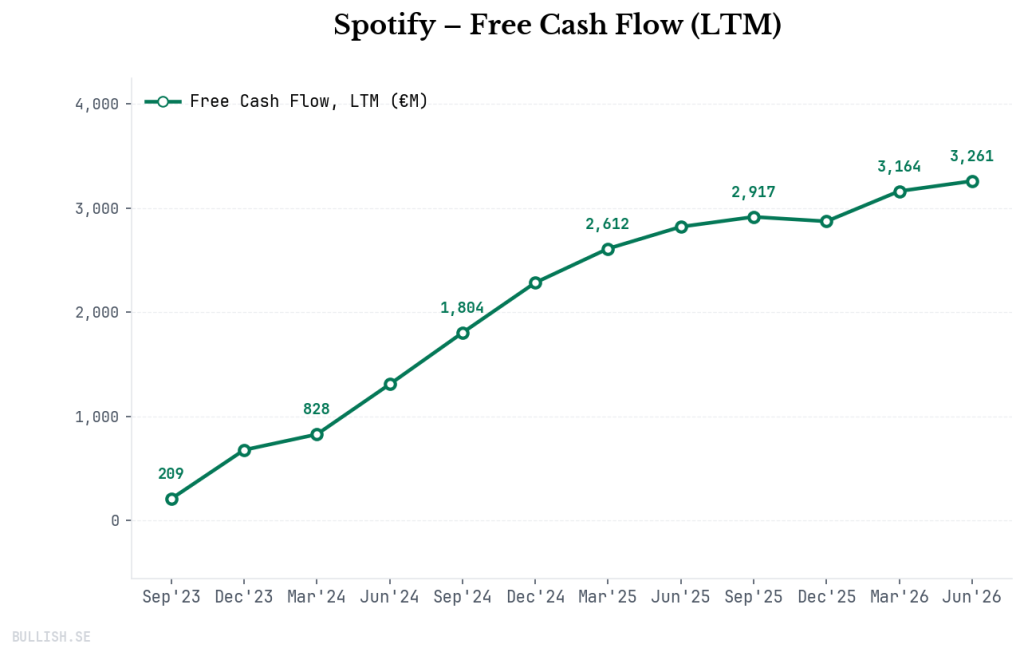
            <li class="font-serif text-sm text-gray-900 dark:text-gray-200">Spotify is the freemium audio marketplace that finally figured out how to convert scale into cash, not just users.</li><li class="font-serif text-sm text-gray-900 dark:text-gray-200">Gross margin has expanded for six consecutive quarters, hitting a record 33.4 percent in Q2 2026, and the company just wiped out its only meaningful debt.</li><li class="font-serif text-sm text-gray-900 dark:text-gray-200">The real risk isn&#8217;t Apple or Amazon &mdash; it&#8217;s that roughly 72 percent of everything streamed on the platform runs through licensing deals with three record labels that Spotify doesn&#8217;t fully control.</li><li class="font-serif text-sm text-gray-900 dark:text-gray-200">Free cash flow on a trailing-twelve-month basis has grown from 209 million euros in September 2023 to 3.26 billion euros today, a nearly sixteen-fold increase in under three years.</li><li class="font-serif text-sm text-gray-900 dark:text-gray-200">My take: this is a buy, but not a screaming one &mdash; the operating story has clearly turned, yet the stock&#8217;s valuation already assumes several more years of exactly this kind of execution.</li>        </ul>
    </div>
</div>
<div class="expand-button-content bg-gray-100 dark:bg-gray-800 border border-t-0 border-gray-200 dark:border-gray-700 max-w-xl mb-8 mx-auto rounded-bl rounded-br text-center">
    <button class="expand-button">
        <span class="button-text font-jetbrains uppercase">Show more</span>
        <span class="arrow">&#x2193;</span>
    </button>
</div>


<h3 class="wp-block-heading">What Spotify Actually Sells</h3>


<p class="wp-block-paragraph">Spotify runs a two-sided marketplace, not just a streaming app. On one side sit 777 million monthly active users, split between 300 million paying Premium subscribers and 494 million ad-supported listeners who cost the company almost nothing to serve beyond bandwidth and licensing. </p>


<p class="wp-block-paragraph">On the other side sit the rights holders — record labels, podcasters, audiobook publishers — who need Spotify&#8217;s distribution and, increasingly, its marketing tools and analytics to reach an audience they couldn&#8217;t otherwise assemble on their own.</p>


<p class="wp-block-paragraph">The Premium side is straightforward: subscribers pay a monthly fee across Individual, Family, Duo, and Student tiers, and Spotify keeps the difference between that fee and what it owes in royalties. </p>


<p class="wp-block-paragraph">The Ad-Supported side monetizes the free tier through display, audio, and video advertising, increasingly sold through automated exchanges rather than direct sales teams — a shift that matters because programmatic buying scales without proportional headcount growth. </p>


<p class="wp-block-paragraph">Together, these segments generated 4.78 billion euros in the second quarter, up 14 percent year over year.</p>


<p class="wp-block-paragraph">What makes the model interesting isn&#8217;t the subscription mechanic itself — that&#8217;s Netflix&#8217;s playbook too. </p>


<p class="wp-block-paragraph">It&#8217;s that Spotify doesn&#8217;t own the content it sells. Roughly 72 percent of everything streamed runs through licensing agreements with Universal Music Group, Sony Music Entertainment, and Warner Music Group, plus Merlin for independent labels. </p>


<p class="wp-block-paragraph">That&#8217;s the defining structural feature of this business: Spotify controls distribution and discovery, but not the underlying product. </p>


<p class="wp-block-paragraph">Every dollar of gross margin expansion has come from growing revenue faster than a royalty base Spotify can&#8217;t unilaterally renegotiate downward.</p>


<p class="wp-block-paragraph">The company is now pushing into adjacent marketplace products that widen the moat a little further from pure distribution. </p>


<p class="wp-block-paragraph">Audiobooks+ add-on tiers, a Reserved concert-ticket program built with Live Nation that&#8217;s already moved nearly 100,000 tickets, and AI-generated Personal Podcasts are all attempts to build revenue streams where Spotify captures more value per user without needing new licensing leverage over the majors.</p>


<h3 class="wp-block-heading">The Numbers That Aren&#8217;t on the Press Release</h3>


<p class="wp-block-paragraph">Start with the one everyone quoted: gross margin at 33.4 percent, up 193 basis points year over year. </p>


<p class="wp-block-paragraph">That&#8217;s a record, and it&#8217;s not a one-quarter fluke — margin has now expanded in Premium (34.9 percent, up 174 basis points) and Ad-Supported (19.1 percent, up 179 basis points) simultaneously, which tells you the improvement isn&#8217;t just a mix shift toward the higher-margin subscription business. </p>


<p class="wp-block-paragraph">Both halves of the company are getting more efficient at the same time.</p>


<p class="wp-block-paragraph">Operating income tells a similar story but with more drama: 655 million euros in the quarter, up 61 percent year over year, against an operating loss of 446 million euros for the entirety of 2023. </p>


<p class="wp-block-paragraph">That&#8217;s not incremental improvement — that&#8217;s a business that crossed a structural threshold.</p>


<p class="wp-block-paragraph">Then there&#8217;s the balance sheet move that got comparatively little attention: Spotify fully repaid its Exchangeable Notes — 1.3 billion euros — during the first quarter of 2026. </p>


<p class="wp-block-paragraph">The company now sits in a net cash position, with roughly 10.5 billion euros in cash, short-term, and long-term investments and effectively zero financial debt. </p>


<p class="wp-block-paragraph">Combine that with accelerating buybacks — 662 million dollars repurchased year-to-date through early August, up 30 percent from the same period a year ago — and you have a company that&#8217;s gone from cash-burning growth story to disciplined capital allocator in under three years.</p>


<p class="wp-block-paragraph">Premium ARPU is the one number that doesn&#8217;t fit the clean narrative. It actually fell 1 percent for full-year 2025, to 4.63 euros, as currency headwinds and product mix offset price increases. </p>


<p class="wp-block-paragraph">Worth watching, because ARPU softness is exactly the kind of thing that can quietly erode margin gains if it persists.</p>


<p class="wp-block-paragraph">But the number I watch most closely is free cash flow on a trailing-twelve-month basis, because it strips out the noise in quarterly operating income — including the currency-linked &#8221;Social Charges&#8221; swings the company itself flags as volatile — and shows the underlying cash generation trend without distortion.</p>


<figure class="wp-block-table"><table><thead><tr><th>Metric</th><th>Value</th><th>Context</th></tr></thead><thead><tr><td>Gross margin (Q2 2026)</td><td>33.4%</td><td>Record high, up 193 bps YoY, sixth straight quarter of expansion</td></tr></thead><tbody><tr><td>Operating income (Q2 2026)</td><td>€655M</td><td>Up 61% YoY; vs. a full-year operating loss of €446M in 2023</td></tr><tr><td>Free cash flow (LTM)</td><td>€3,261M</td><td>Up from €209M in September 2023</td></tr><tr><td>Premium subscribers</td><td>300M</td><td>+9% YoY; crossed the 300M milestone this quarter</td></tr><tr><td>Net financial debt</td><td>None</td><td>Exchangeable Notes fully repaid in Q1 2026; net cash position</td></tr></tbody></table></figure>


<h2 class="wp-block-heading">What the Chart Isn&#8217;t Telling You About the Margin Story</h2>


<p class="wp-block-paragraph">The trailing-twelve-month free cash flow chart above looks almost too clean — a nearly uninterrupted climb from 209 million euros to 3.26 billion euros in under three years. </p>


<figure data-wp-context="{&quot;imageId&quot;:&quot;6a960c322700e&quot;}" data-wp-interactive="core/image" data-wp-key="6a960c322700e" class="wp-block-image size-large wp-lightbox-container"><img decoding="async" width="1024" height="656" data-wp-class--hide="state.isContentHidden" data-wp-class--show="state.isContentVisible" data-wp-init="callbacks.setButtonStyles" data-wp-on--click="actions.showLightbox" data-wp-on--load="callbacks.setButtonStyles" data-wp-on--pointerdown="actions.preloadImage" data-wp-on--pointerenter="actions.preloadImageWithDelay" data-wp-on--pointerleave="actions.cancelPreload" data-wp-on-window--resize="callbacks.setButtonStyles" src="https://bullish.se/wp-content/uploads/2026/08/SPOT-Spotify-Technology-S.A.-Chart-Free-Cash-Flow-LTM-2026-08-08-1024x656.png" alt="" class="wp-image-2403" srcset="https://bullish.se/wp-content/uploads/2026/08/SPOT-Spotify-Technology-S.A.-Chart-Free-Cash-Flow-LTM-2026-08-08-1024x656.png 1024w, https://bullish.se/wp-content/uploads/2026/08/SPOT-Spotify-Technology-S.A.-Chart-Free-Cash-Flow-LTM-2026-08-08-300x192.png 300w, https://bullish.se/wp-content/uploads/2026/08/SPOT-Spotify-Technology-S.A.-Chart-Free-Cash-Flow-LTM-2026-08-08-768x492.png 768w, https://bullish.se/wp-content/uploads/2026/08/SPOT-Spotify-Technology-S.A.-Chart-Free-Cash-Flow-LTM-2026-08-08.png 1284w" sizes="(max-width: 1024px) 100vw, 1024px" /><button
			class="lightbox-trigger"
			type="button"
			aria-haspopup="dialog"
			data-wp-bind--aria-label="state.thisImage.triggerButtonAriaLabel"
			data-wp-init="callbacks.initTriggerButton"
			data-wp-on--click="actions.showLightbox"
			data-wp-style--right="state.thisImage.buttonRight"
			data-wp-style--top="state.thisImage.buttonTop"
		>
			<svg xmlns="http://www.w3.org/2000/svg" width="12" height="12" fill="none" viewBox="0 0 12 12">
				<path fill="#fff" d="M2 0a2 2 0 0 0-2 2v2h1.5V2a.5.5 0 0 1 .5-.5h2V0H2Zm2 10.5H2a.5.5 0 0 1-.5-.5V8H0v2a2 2 0 0 0 2 2h2v-1.5ZM8 12v-1.5h2a.5.5 0 0 0 .5-.5V8H12v2a2 2 0 0 1-2 2H8Zm2-12a2 2 0 0 1 2 2v2h-1.5V2a.5.5 0 0 0-.5-.5H8V0h2Z" />
			</svg>
		</button><figcaption class="wp-element-caption">Source: Spotify Q2 2026 Shareholder Update (Reconciliation of IFRS to Non-IFRS Results). Data as of 2026-08-04.</figcaption></figure>


<p class="wp-block-paragraph">What it doesn&#8217;t show is how lumpy the underlying quarters were to get there: capital expenditures remain minimal (21 million euros in the latest quarter, under half a percent of revenue), so this isn&#8217;t a capex story. </p>


<p class="wp-block-paragraph">It&#8217;s almost entirely an operating income and working capital story, which means the trend is more durable than a chart driven by one-off asset sales or tax credits would be. </p>


<p class="wp-block-paragraph">The flattening between September and December 2025 — 2,917 million to 2,874 million euros — is the only real pause in an otherwise relentless line, and it lines up with typical seasonal working capital timing rather than any deterioration in the underlying business.</p>


<h3 class="wp-block-heading">The Market Has Already Priced In the Easy Part</h3>


<p class="wp-block-paragraph">Wall Street&#8217;s read on Spotify right now is straightforward: analyst consensus leans heavily bullish, with buy ratings dominating across every source I checked</p>


<p class="wp-block-paragraph">, and average price targets clustered somewhere between 585 and 620 dollars depending on which aggregator you trust — a meaningful spread on its own, worth noting. </p>


<p class="wp-block-paragraph">That&#8217;s roughly 20 to 25 percent upside from current levels.</p>


<div class="wp-block-bullish-tracker-tradingview-ticker">
    <tv-single-ticker symbol="NYSE:SPOT"></tv-single-ticker>
</div>


<p class="wp-block-paragraph">Here&#8217;s my pushback: the market isn&#8217;t wrong that the margin story is real, but a forward P/E above 30 times and an EV/EBITDA near 21 times already assumes this expansion continues for several more years without a hiccup. </p>


<p class="wp-block-paragraph">Compare that to SiriusXM, trading at roughly 7.7 times EV/EBITDA — a genuinely unfair comparison given SiriusXM is a structurally shrinking satellite radio business, but it&#8217;s illustrative of just how much growth and margin durability the market is underwriting in Spotify&#8217;s multiple. </p>


<p class="wp-block-paragraph">The easy part — proving the business could be profitable at all — is done and priced in. </p>


<p class="wp-block-paragraph">The harder part, sustaining double-digit margin gains against a royalty structure Spotify doesn&#8217;t control, is the actual bet investors are making now.</p>


<h2 class="wp-block-heading">The One Risk Analysts Keep Underweighting</h2>


<p class="wp-block-paragraph">Three risks are worth real attention here, and only one of them gets proportional coverage.</p>


<p class="wp-block-paragraph">The first, and the one everyone talks about, is competition from Apple, Amazon, and YouTube Music — companies that can subsidize a streaming product with hardware or retail margins Spotify doesn&#8217;t have. </p>


<p class="wp-block-paragraph">It&#8217;s real, but Spotify has weathered it for a decade without losing its lead in monthly active users, so I&#8217;d argue this risk is already reasonably well understood and priced.</p>


<p class="wp-block-paragraph">The second is governance, and it&#8217;s genuinely underdiscussed. </p>


<p class="wp-block-paragraph">Founders Daniel Ek and Martin Lorentzon together control 69.3 percent of voting power through a beneficiary-certificate structure, despite owning only around 23 percent of the economic shares. </p>


<p class="wp-block-paragraph">If the newly installed co-CEO structure — Alex Norström and Gustav Söderström, in the roles since January 2026 — runs into strategic disagreement with outside shareholders, there&#8217;s essentially no mechanism for those shareholders to force a change. </p>


<p class="wp-block-paragraph">This isn&#8217;t a near-term catalyst, but it&#8217;s a standing feature of the risk profile that gets far less airtime than it deserves relative to its potential impact.</p>


<p class="wp-block-paragraph">The third, and the one I think matters most financially, is licensing concentration. </p>


<p class="wp-block-paragraph">Spotify&#8217;s entire gross margin story depends on growing revenue faster than royalty costs set largely by three record labels with &#8221;most favored nation&#8221; clauses in their contracts. </p>


<p class="wp-block-paragraph">If any of Universal, Sony, or Warner extracts materially worse terms at the next renewal — and these are multi-year, not automatically renewable agreements — the margin expansion that&#8217;s driving this entire investment case could stall or reverse in a way that has nothing to do with subscriber growth or competitive pressure.</p>


<h3 class="wp-block-heading">The Verdict</h3>


<p class="wp-block-paragraph">I think Spotify has genuinely earned its re-rating from cash-burning growth story to disciplined, profitable platform business — the margin data across six straight quarters is too consistent to dismiss as noise. </p>


<p class="wp-block-paragraph">But the stock isn&#8217;t cheap anymore, and at a forward P/E above 30 times, there&#8217;s limited room for anything to go wrong on the licensing side or in Premium ARPU before the multiple starts to look like the problem rather than the opportunity.</p>


<p class="wp-block-paragraph">What would change my mind in either direction:</p>


<ul class="wp-block-list">
<li>A Q3 2026 print that misses guidance on gross margin as well as subscriber adds — not just one metric — would suggest the expansion is decelerating faster than the market expects.</li>


<li>Any public signal of tension in the upcoming licensing renewal cycle with Universal, Sony, or Warner would be the single biggest threat to the entire margin thesis.</li>


<li>Continued ARPU weakness beyond currency effects into 2026 would be the clearest sign that pricing power is softer than the headline numbers suggest.</li>
</ul>


<p class="wp-block-paragraph">This is a stock for the investor who wants exposure to a genuine, multi-year platform margin story with a fortress balance sheet behind it — not for anyone looking for a cheap entry point. </p>


<p class="wp-block-paragraph">If you&#8217;re underwriting Spotify here, you&#8217;re underwriting continued flawless execution against a licensing structure the company doesn&#8217;t fully control, and paying a growth-stock multiple for the privilege.</p>


<figure class="wp-block-table"><table><thead><tr><th>Field</th><th>Value</th></tr></thead><thead><tr><td>Stock(s)</td><td>Spotify Technology S.A.</td></tr></thead><tbody><tr><td>Ticker</td><td>SPOT</td></tr><tr><td>Exchange / List</td><td>NYSE, Large Cap</td></tr><tr><td>Sector</td><td>Audio streaming / digital media</td></tr><tr><td>Share price</td><td>$490.28 (August 7, 2026)</td></tr><tr><td>Market cap</td><td>~$100–101 billion</td></tr><tr><td>Dividend</td><td>No</td></tr><tr><td>Next report</td><td>Approximately October 27–November 3, 2026 (exact date varies by source)</td></tr></tbody></table></figure>


<p class="wp-block-paragraph"></p>
]]></content>
		
			</entry>
		<entry>
		<author>
			<name>Bullish</name>
							<uri>https://bullish.se</uri>
						</author>

		<title type="html"><![CDATA[Klarna Q2 – A Clean Beat the Market Didn’t Trust]]></title>
		<link rel="alternate" type="text/html" href="https://bullish.se/brief/2026/08/18/klarna-q2-a-clean-beat-the-market-didnt-trust/" />

		<id>https://bullish.se/brief/2026/08/18//</id>
		<updated>2026-08-18T14:54:02Z</updated>
		<published>2026-08-18T14:53:18Z</published>
		<category scheme="https://bullish.se" term="Earnings Update" /><category scheme="https://bullish.se" term="Klarna" /><category scheme="https://bullish.se" term="Q2 2026" />
		<summary type="html"><![CDATA[Klarna, the Stockholm-founded buy-now-pay-later network now listed on the NYSE, reported second-quarter 2026 results on August 18.]]></summary>

					<content type="html" xml:base="https://bullish.se/brief/2026/08/18/klarna-q2-a-clean-beat-the-market-didnt-trust/"><![CDATA[
<p class="wp-block-paragraph">Klarna, the Stockholm-founded buy-now-pay-later network now listed on the NYSE, <a href="https://s205.q4cdn.com/644747736/files/doc_earnings/2026/q2/earnings-result/Q2-26-Klarna-Group-plc-Earnings-Release.pdf" target="_blank" rel="noreferrer noopener">reported second-quarter 2026 results</a> today. </p>


<p class="wp-block-paragraph">Revenue rose 27 percent year-over-year to $1.042 billion, beating the roughly $997 million analyst consensus, while EPS came in at $0.01 against a consensus loss of $0.05. </p>


<p class="wp-block-paragraph">Operating income turned to $27 million, well ahead of the -$6 million the Street had modeled.</p>


<figure class="wp-block-table"><table><thead><tr><th></th><th>Consensus est.</th><th>Actual Q2 2026</th><th>Beat/Miss</th></tr></thead><thead><tr><td>Revenue</td><td>$997m</td><td>$1,042m</td><td>Beat</td></tr></thead><tbody><tr><td>EBIT (operating income)</td><td>($6)m</td><td>$27m</td><td>Beat</td></tr><tr><td>EPS</td><td>($0.05)</td><td>$0.01</td><td>Beat</td></tr></tbody></table></figure>


<p class="wp-block-paragraph">The number that actually matters here isn’t the top line — it’s transaction margin dollars, which grew 42 percent to $446 million and reached 42.8 percent of revenue, up more than 4.5 percentage points sequentially. </p>


<p class="wp-block-paragraph">That’s Klarna’s own preferred yardstick, and it grew faster than revenue, which grew faster than GMV — exactly the sequencing management wants investors to see. </p>


<p class="wp-block-paragraph">What buried all of it: full-year GMV guidance was cut to $149-151 billion from above $155 billion, and revenue guidance dropped to $4.08-4.16 billion from above $4.34 billion, with Q3 adjusted operating income guided at just $5-15 million as Klarna front-loads spending on new PSP launches ahead of peak season.</p>


<p class="wp-block-paragraph">What strikes me is that this was, by the numbers, one of Klarna’s cleanest quarters yet — and the stock still fell about 19 percent. </p>


<p class="wp-block-paragraph">That tells you the market is no longer grading Klarna on the quarter it just delivered; it’s grading the credibility of the guidance band itself, and a second guidance revision in three quarters isn’t building that credibility. </p>


<p class="wp-block-paragraph">Germany’s retail slowdown, cited as the main driver of the cut, is the thing I’d watch into Q3.</p>
]]></content>
		
			</entry>
		<entry>
		<author>
			<name>Bullish</name>
							<uri>https://bullish.se</uri>
						</author>

		<title type="html"><![CDATA[JPMorgan Sees Klarna Undervalued vs. Affirm ahead of Q2 Report]]></title>
		<link rel="alternate" type="text/html" href="https://bullish.se/brief/2026/08/17/jpmorgan-sees-klarna-undervalued-vs-affirm-ahead-of-q2-report/" />

		<id>https://bullish.se/brief/2026/08/17//</id>
		<updated>2026-08-17T17:35:54Z</updated>
		<published>2026-08-17T17:35:51Z</published>
		<category scheme="https://bullish.se" term="News Brief" /><category scheme="https://bullish.se" term="Klarna" />
		<summary type="html"><![CDATA[Swedish fintech company Klarna, which listed in New York last year, has seen its shares climb nearly 70 percent since an April low, but JPMorgan argues the stock still trades at too steep a discount to US rival Affirm, according to EFN. Klarna&#8217;s stock debuted at 40 dollars before slumping to around 12 dollars within [&#8230;]]]></summary>

					<content type="html" xml:base="https://bullish.se/brief/2026/08/17/jpmorgan-sees-klarna-undervalued-vs-affirm-ahead-of-q2-report/"><![CDATA[
<p class="wp-block-paragraph">Swedish fintech company Klarna, which listed in New York last year, has seen its shares climb nearly 70 percent since an April low, but JPMorgan argues the stock still trades at too steep a discount to US rival Affirm, according to <a href="https://efn.se/bankjatten-klarna-billig-jamfort-med-konkurrent" target="_blank" rel="noopener noreferrer">EFN</a>.</p>


<p class="wp-block-paragraph">Klarna&#8217;s stock debuted at 40 dollars before slumping to around 12 dollars within six months. It has since recovered to about 20 dollars, helped by positive news including a partnership with Apple that lets customers upgrade devices through a leasing scheme in the Klarna app. JPMorgan called the deal attractive for Klarna&#8217;s brand value.</p>


<p class="wp-block-paragraph">The bank also cited Klarna&#8217;s US expansion, which brings longer, more profitable loans, potentially supporting annual revenue growth above 15 percent and margin expansion of roughly 15 percentage points by 2028.</p>


<p class="wp-block-paragraph">JPMorgan forecasts second-quarter revenue of 992 million dollars, up 21 percent year-on-year, and gross merchandise value of 36.255 billion dollars, near the top of Klarna&#8217;s own guidance range, which it called conservative.</p>


<p class="wp-block-paragraph">Of 25 analysts covering Klarna, 15 rate it buy and 10 hold, with an average price target of 23.27 dollars. Klarna reports second-quarter earnings on Tuesday, August 18.</p>


<p class="wp-block-paragraph"></p>
]]></content>
		
			</entry>
		<entry>
		<author>
			<name>Bullish</name>
							<uri>https://bullish.se</uri>
						</author>

		<title type="html"><![CDATA[The Eleven-Times Discount: What the Market Thinks It Knows About Novo Nordisk]]></title>
		<link rel="alternate" type="text/html" href="https://bullish.se/2026/08/16/the-eleven-times-discount-what-the-market-thinks-it-knows-about-novo-nordisk/" />

		<id>https://bullish.se/?p=2351</id>
		<updated>2026-08-08T21:26:37Z</updated>
		<published>2026-08-16T06:00:00Z</published>
		<category scheme="https://bullish.se" term="Company Deep-Dive" /><category scheme="https://bullish.se" term="Novo Nordisk" />
		<summary type="html"><![CDATA[Novo Nordisk is the company that turned a decades-old diabetes franchise into the world&#8217;s dominant obesity-drug business, built on semaglutide &#8212; sold as Ozempic and Wegovy. My take: this isn&#8217;t a value trap, but it isn&#8217;t a clean buy either &#8212; the discount to Lilly won&#8217;t close until CagriSema proves it can compete, and betting on that outcome is a clinical call dressed up as a valuation call.]]></summary>

					<content type="html" xml:base="https://bullish.se/2026/08/16/the-eleven-times-discount-what-the-market-thinks-it-knows-about-novo-nordisk/"><![CDATA[
<p class="wp-block-paragraph">Here’s the thing about Novo Nordisk that gets lost in the noise around its stock price: the company didn’t stumble into the obesity boom. </p>


<p class="wp-block-paragraph">It manufactured it, patiently, over a decade of semaglutide research that most of the market ignored until Wegovy’s launch turned it into a household name. </p>


<figure data-wp-context="{&quot;imageId&quot;:&quot;6a960c322f7bb&quot;}" data-wp-interactive="core/image" data-wp-key="6a960c322f7bb" class="wp-block-image size-large wp-lightbox-container"><img loading="lazy" decoding="async" width="1024" height="576" data-wp-class--hide="state.isContentHidden" data-wp-class--show="state.isContentVisible" data-wp-init="callbacks.setButtonStyles" data-wp-on--click="actions.showLightbox" data-wp-on--load="callbacks.setButtonStyles" data-wp-on--pointerdown="actions.preloadImage" data-wp-on--pointerenter="actions.preloadImageWithDelay" data-wp-on--pointerleave="actions.cancelPreload" data-wp-on-window--resize="callbacks.setButtonStyles" src="https://bullish.se/wp-content/uploads/2026/08/cq5dam.web_.2000.2000-e1785966502437-1024x576.jpeg" alt="" class="wp-image-2350" srcset="https://bullish.se/wp-content/uploads/2026/08/cq5dam.web_.2000.2000-e1785966502437-1024x576.jpeg 1024w, https://bullish.se/wp-content/uploads/2026/08/cq5dam.web_.2000.2000-e1785966502437-300x169.jpeg 300w, https://bullish.se/wp-content/uploads/2026/08/cq5dam.web_.2000.2000-e1785966502437-768x432.jpeg 768w, https://bullish.se/wp-content/uploads/2026/08/cq5dam.web_.2000.2000-e1785966502437-1200x675.jpeg 1200w, https://bullish.se/wp-content/uploads/2026/08/cq5dam.web_.2000.2000-e1785966502437.jpeg 1333w" sizes="auto, (max-width: 1024px) 100vw, 1024px" /><button
			class="lightbox-trigger"
			type="button"
			aria-haspopup="dialog"
			data-wp-bind--aria-label="state.thisImage.triggerButtonAriaLabel"
			data-wp-init="callbacks.initTriggerButton"
			data-wp-on--click="actions.showLightbox"
			data-wp-style--right="state.thisImage.buttonRight"
			data-wp-style--top="state.thisImage.buttonTop"
		>
			<svg xmlns="http://www.w3.org/2000/svg" width="12" height="12" fill="none" viewBox="0 0 12 12">
				<path fill="#fff" d="M2 0a2 2 0 0 0-2 2v2h1.5V2a.5.5 0 0 1 .5-.5h2V0H2Zm2 10.5H2a.5.5 0 0 1-.5-.5V8H0v2a2 2 0 0 0 2 2h2v-1.5ZM8 12v-1.5h2a.5.5 0 0 0 .5-.5V8H12v2a2 2 0 0 1-2 2H8Zm2-12a2 2 0 0 1 2 2v2h-1.5V2a.5.5 0 0 0-.5-.5H8V0h2Z" />
			</svg>
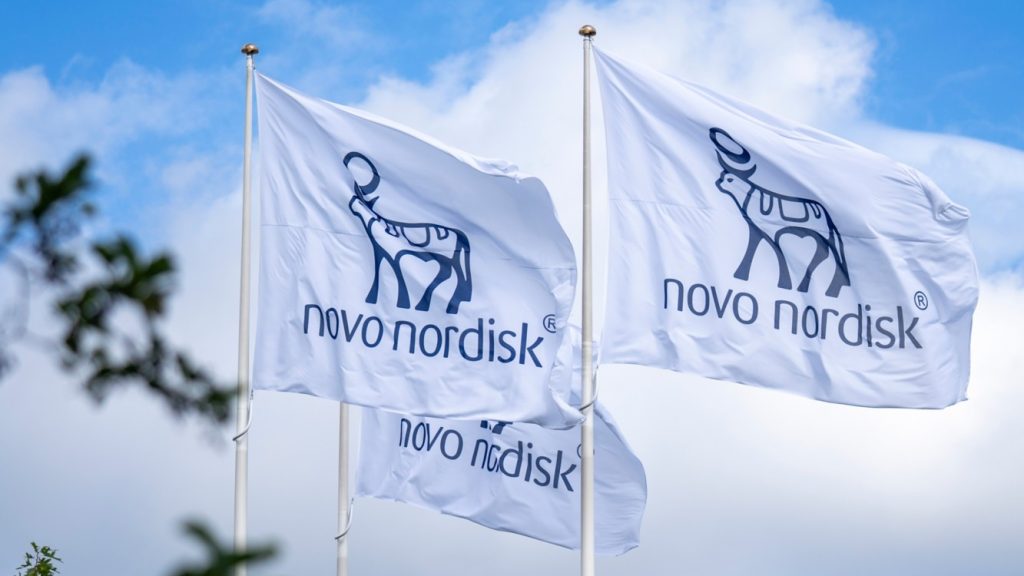
		</button><figcaption class="wp-element-caption">Photo: Novo Nordisk</figcaption></figure>


<p class="wp-block-paragraph">That’s the backdrop worth holding onto, because the last eighteen months look, on the surface, like a company falling apart.</p>


<p class="wp-block-paragraph">The share price is down 48 percent since the end of 2024.</p>


<p class="wp-block-paragraph">Its most important pipeline asset has now failed to hit its primary target twice. And yet the company just raised its full-year guidance for the second consecutive quarter.</p>


<p class="wp-block-paragraph">Both things are true at once, and untangling them is the whole game.</p>


<div class="post-summary bg-gray-100 dark:bg-gray-800 border border-gray-200 dark:border-gray-700 max-w-xl mx-auto p-4 pb-2 rounded-tl rounded-tr">
    <h5 class="wp-block-heading font-jetbrains !text-gray-900 dark:!text-gray-200">TL;DR</h5>
    <div class="summary-content text-gray-900 dark:text-gray-200">
        <ul class="list-disc pl-4 text-left marker:text-gray-900 dark:marker:text-gray-200">
            <li class="font-serif text-sm text-gray-900 dark:text-gray-200">Novo Nordisk is the company that turned a decades-old diabetes franchise into the world’s dominant obesity-drug business, built on semaglutide — sold as Ozempic and Wegovy.</li><li class="font-serif text-sm text-gray-900 dark:text-gray-200">The strongest argument for the stock right now is arithmetic: it trades at roughly a quarter of Eli Lilly’s earnings multiple while still leading new-patient starts in the US obesity market.</li><li class="font-serif text-sm text-gray-900 dark:text-gray-200">The risk that actually matters isn’t pricing pressure — it’s that CagriSema, the drug meant to be Novo’s answer to Lilly’s tirzepatide, has now disappointed twice in nine months.</li><li class="font-serif text-sm text-gray-900 dark:text-gray-200">Adjusted sales grew just 2 percent at constant exchange rates in the first half of 2026, against 25 to 35 percent annual growth as recently as 2022 to 2024, while gross margin compressed by nearly 4 percentage points year-on-year.</li><li class="font-serif text-sm text-gray-900 dark:text-gray-200">My take: this isn’t a value trap, but it isn’t a clean buy either — the discount to Lilly won’t close until CagriSema proves it can compete, and betting on that outcome is a clinical call dressed up as a valuation call.</li>        </ul>
    </div>
</div>
<div class="expand-button-content bg-gray-100 dark:bg-gray-800 border border-t-0 border-gray-200 dark:border-gray-700 max-w-xl mb-8 mx-auto rounded-bl rounded-br text-center">
    <button class="expand-button">
        <span class="button-text font-jetbrains uppercase">Show more</span>
        <span class="arrow">&#x2193;</span>
    </button>
</div>


<h3 class="wp-block-heading">Semaglutide, Sold Two Ways</h3>


<p class="wp-block-paragraph">Novo Nordisk’s business is deceptively simple to describe and genuinely hard to replicate: one molecule, semaglutide, sold under different brand names into two related but distinct markets.</p>


<p class="wp-block-paragraph">Ozempic and Rybelsus treat type 2 diabetes; Wegovy, in injectable and – since January 2026 – pill form, treats obesity.</p>


<p class="wp-block-paragraph">Both work by mimicking GLP-1, a gut hormone that regulates appetite and blood sugar.</p>


<p class="wp-block-paragraph">The commercial insight was recognizing, earlier than most competitors, that the same drug class could anchor two enormous and overlapping markets.</p>


<p class="wp-block-paragraph">What’s easy to miss is how much of the current story runs through distribution, not chemistry.</p>


<p class="wp-block-paragraph">Wegovy’s oral pill crossed 5 million prescriptions in the US since its January launch and reached roughly 265,000 weekly prescriptions by mid-July — the strongest GLP-1 volume launch the market has seen.</p>


<p class="wp-block-paragraph">That’s not just a new SKU; it’s a wedge into a self-pay and telehealth channel (NovoCare Pharmacy, plus partnerships with Ro, WeightWatchers, and LifeMD) that operates almost entirely outside the traditional insurance-and-PBM system Novo has spent decades navigating.</p>


<p class="wp-block-paragraph">It’s a genuinely different go-to-market motion, running in parallel with the legacy insured channel.</p>


<div class="wp-block-bullish-tracker-tradingview-ticker">
    <tv-single-ticker symbol="OMXCOP:NOVO_B"></tv-single-ticker>
</div>


<p class="wp-block-paragraph">The strategic pivot underneath all of this is pricing, not product.</p>


<p class="wp-block-paragraph">Novo signed a “Most Favoured Nations” agreement with the US administration in late 2025, and starting January 2027 it will cut US list prices on Wegovy and Ozempic by roughly 50 and 35 percent, respectively.</p>


<p class="wp-block-paragraph">That’s the trade the company is making explicitly: give up price to defend volume and expand access, on the bet that GLP-1 penetration in a market of roughly a billion people living with obesity still has enormous room to run.</p>


<h3 class="wp-block-heading">The Numbers That Matter</h3>


<p class="wp-block-paragraph">Start with the one that should worry anyone modeling Novo Nordisk off its historical growth rate: adjusted sales grew just 2 percent at constant exchange rates in the first half of 2026. </p>


<p class="wp-block-paragraph">That’s not a rounding error — it’s a cliff relative to the 25 to 35 percent annual growth the company posted every year from 2022 through 2024. </p>


<p class="wp-block-paragraph">Reported growth looks far better (18 percent in H1), but that’s almost entirely a function of a one-off DKK 26.8 billion reversal of US rebate provisions booked in the first quarter — strip that out, and the underlying business is barely expanding.</p>


<p class="wp-block-paragraph">Margin tells a similar story. </p>


<p class="wp-block-paragraph">Adjusted gross margin fell to 79.3 percent in H1 2026 from 83.1 percent a year earlier, hit by lower realized US prices, roughly DKK 3 billion in one-off manufacturing right-sizing costs, and currency drag.</p>


<p class="wp-block-paragraph">That’s a nearly four-point compression in two quarters for a company whose margin structure used to be a point of near-total stability.</p>


<p class="wp-block-paragraph">Then there’s the segment detail that doesn’t show up in the headline figures: Wegovy injectable sales in the US fell 22 percent at constant currency in the second quarter, even as the Wegovy pill grew from nothing.</p>


<p class="wp-block-paragraph">That’s not simply substitution — a meaningful chunk of that injectable decline is lower realized pricing, which means Novo is trading price for volume inside its own franchise before the 2027 list-price cut has even landed. If that’s happening now, the margin math for 2027 and beyond deserves real scrutiny, not just a guidance-range assumption.</p>


<p class="wp-block-paragraph">Against that backdrop, the guidance revision looks less impressive than the headline suggests. Novo raised full-year 2026 adjusted sales and operating profit growth guidance from a range of -4 percent to -12 percent (as of May) to 0 percent to -6 percent (as of August) — both in constant currency. </p>


<p class="wp-block-paragraph">That’s a real improvement, but the starting point was already a guidance cut from the growth rates investors got used to. </p>


<p class="wp-block-paragraph">The number I watch most closely is that adjusted sales growth figure, because it’s the cleanest read on whether the deceleration from 31 percent (2023) to 6 percent (2025) has actually found a floor, or is still searching for one.</p>


<figure class="wp-block-table"><table><thead><tr><th>Metric</th><th>Value</th><th>Context</th></tr></thead><thead><tr><td>Adjusted sales growth, H1 2026 (CER)</td><td>+2%</td><td>Down from 25-35% annual growth in 2022-2024</td></tr></thead><tbody><tr><td>Adjusted gross margin, H1 2026</td><td>79.3%</td><td>Down from 83.1% in H1 2025</td></tr><tr><td>Free cash flow, H1 2026</td><td>DKK 55.3bn</td><td>Up 44% year-on-year</td></tr><tr><td>Net debt / EBITDA (TTM, estimated)</td><td>~0.5x</td><td>Net cash position since 2024</td></tr><tr><td>P/E (TTM, adjusted, estimated)</td><td>~11x</td><td>Versus roughly 40x for Eli Lilly</td></tr></tbody></table></figure>


<h3 class="wp-block-heading">What the Chart Isn’t Telling You About the Growth Story</h3>


<p class="wp-block-paragraph">The five-year sales chart looks, at a glance, like a company still compounding nicely — the bars keep climbing, right through 2025. </p>


<p class="wp-block-paragraph">That’s true in absolute terms and almost beside the point. </p>


<p class="wp-block-paragraph">What matters is the second line: growth of 31 percent in 2023, 25 percent in 2024, and just 6 percent in 2025, with the underlying (adjusted) figure for H1 2026 running at only 2 percent. </p>


<p class="wp-block-paragraph">The share price has already done the work of pricing that deceleration in — it’s why the stock sits near DKK 292 today versus DKK 624 at the end of 2024, a nearly 50 percent drawdown that happened before this week’s earnings reaction even started. </p>


<p class="wp-block-paragraph">What the chart can’t show is whether 2025’s growth rate is the new cruising altitude or still a plane in descent; that’s a forward-looking question the historical numbers simply can’t answer on their own.</p>


<h3 class="wp-block-heading">The Market Is Pricing Novo as a Value Stock, Not a Growth Stock — And That’s the Real Story</h3>


<p class="wp-block-paragraph">Here’s what’s actually interesting: the market isn’t debating whether Novo Nordisk is a good business anymore. It’s debating whether it’s still a growth business at all. </p>


<p class="wp-block-paragraph">At roughly 11 times trailing adjusted earnings, Novo trades closer to how the market prices a mature, ex-growth pharma name than a company still leading the fastest-growing drug category in the industry. Eli Lilly, its closest competitor, trades at nearly four times that multiple.</p>


<p class="wp-block-paragraph">Three ways to read that gap. </p>


<p class="wp-block-paragraph">One: the market is right, and Novo’s growth rate really has structurally reset to low single digits, in which case an 11x multiple is arguably fair, maybe even generous given the pipeline risk. </p>


<p class="wp-block-paragraph">Two: the market is overcorrecting for a string of bad clinical headlines and underpricing a business that still controls the largest obesity franchise on earth. </p>


<p class="wp-block-paragraph">Three — and this is the version I find most persuasive — the market isn’t mispricing Novo so much as refusing to underwrite CagriSema until it sees real data, and that refusal is entirely rational given the trial history. </p>


<p class="wp-block-paragraph">The multiple gap isn’t really about Ozempic or Wegovy. It’s a referendum on whether Novo’s next act will work.</p>


<h2 class="wp-block-heading">The One Risk That Isn’t About Pricing</h2>


<p class="wp-block-paragraph">Everyone talks about US drug pricing when discussing Novo Nordisk, and it’s a legitimate risk — the 2027 list-price cuts of up to 50 percent will compress margin, full stop. </p>


<p class="wp-block-paragraph">But it’s not the risk that should keep an investor up at night, because it’s known, guided, and already partially reflected in the stock.</p>


<p class="wp-block-paragraph">The risk that matters more is CagriSema, the combination amylin-GLP-1 drug Novo needs to keep pace with Eli Lilly’s tirzepatide.</p>


<p class="wp-block-paragraph">It missed non-inferiority against tirzepatide in the REDEFINE 4 head-to-head trial back in February.</p>


<p class="wp-block-paragraph">Then, on the same day as this quarter’s earnings release, a lower-dose readout from REDEFINE 9 landed with less punch than hoped, contributing to a same-day share price decline.</p>


<p class="wp-block-paragraph">Two disappointments in six months, on the company’s single most important next-generation asset, is a pattern, not an anomaly.</p>


<p class="wp-block-paragraph">The second risk worth naming is more unusual: a federal judge in New Jersey recently allowed part of a shareholder lawsuit over CagriSema’s trial communications to proceed, rejecting Novo’s motion to dismiss.</p>


<p class="wp-block-paragraph">The case centers on whether the company misrepresented how consistent its Phase 3 dosing protocol was with earlier trials.</p>


<p class="wp-block-paragraph">Regardless of how the litigation resolves, it signals that some investors believe management’s messaging around CagriSema outran the actual data — a reputational risk that compounds the clinical one.</p>


<p class="wp-block-paragraph">The third: Wegovy injectable’s 22 percent CER sales decline in the US this quarter suggests Novo is already trading price for volume within its own portfolio, before the bigger 2027 price cut even arrives. </p>


<p class="wp-block-paragraph">If that internal cannibalization dynamic worsens, the 2027 guidance assumptions look optimistic rather than conservative.</p>


<h2 class="wp-block-heading">The Verdict</h2>


<p class="wp-block-paragraph">I don’t think Novo Nordisk is broken, and I don’t think it’s cheap in any simple sense either — it’s a business the market has correctly repriced for a genuinely slower growth phase, with real optionality attached if the next pipeline generation delivers.</p>


<p class="wp-block-paragraph">What would change my mind in either direction is specific: a clean, competitive FDA outcome for CagriSema in the second half of 2026 would go a long way toward closing the Lilly valuation gap; a third consecutive disappointment, whether in the FDA review or the REDEFINE 11 readout expected in the first half of 2027, would suggest the market’s skepticism is earned rather than excessive. </p>


<p class="wp-block-paragraph">Between now and then, I’m watching gross margin trajectory in Q3 as the cleanest read on whether the pricing story is stabilizing or still deteriorating.</p>


<p class="wp-block-paragraph">This is a stock for the patient GLP-1 believer who can tolerate binary clinical risk and doesn’t need the growth story to work on this year’s timeline — the cash flow and balance sheet buy you time to wait for CagriSema to either prove itself or get replaced by something else in the pipeline.</p>


<p class="wp-block-paragraph">It’s the wrong stock if you’re underwriting a re-rating on valuation alone: an 11x multiple can go lower, and has, before it goes higher, if the next data readout disappoints again.</p>


<figure class="wp-block-table"><table><thead><tr><th>Field</th><th>Value</th></tr></thead><thead><tr><td>Stock(s)</td><td>Novo Nordisk B</td></tr></thead><tbody><tr><td>Ticker</td><td>NOVO-B.CO (Nasdaq Copenhagen) / NVO (NYSE, ADR)</td></tr><tr><td>Exchange / List</td><td>Nasdaq Copenhagen, Large Cap; ADR on NYSE</td></tr><tr><td>Sector</td><td>Pharmaceuticals – diabetes, obesity, rare disease</td></tr><tr><td>Share price</td><td>DKK 291.7 (Aug 5, 2026)</td></tr><tr><td>Market cap</td><td>~DKK 1,290bn / ~USD 198bn (estimated)</td></tr><tr><td>Dividend</td><td>Yes – DKK 11.70/share for 2025 (yield ~4.0% on current price)</td></tr><tr><td>Next report</td><td>Nov 4, 2026</td></tr></tbody></table></figure>


<p class="wp-block-paragraph"></p>
]]></content>
		
			</entry>
		<entry>
		<author>
			<name>Bullish</name>
							<uri>https://bullish.se</uri>
						</author>

		<title type="html"><![CDATA[Klarna Revamps Membership Tiers to Rival American Express]]></title>
		<link rel="alternate" type="text/html" href="https://bullish.se/brief/2026/08/14/klarna-revamps-membership-tiers-to-rival-american-express/" />

		<id>https://bullish.se/brief/2026/08/14//</id>
		<updated>2026-08-14T19:25:32Z</updated>
		<published>2026-08-14T19:25:28Z</published>
		<category scheme="https://bullish.se" term="News Brief" /><category scheme="https://bullish.se" term="Klarna" />
		<summary type="html"><![CDATA[Klarna, the Swedish payments company, is overhauling its European membership program in a bid to challenge American Express, according to Bloomberg, as reported by EFN. The new structure introduces four tiers priced between 4.99 and 44.99 pounds a month, roughly 65 to 580 SEK. The top-tier card will be made of metal, mirroring Amex&#8217;s premium [&#8230;]]]></summary>

					<content type="html" xml:base="https://bullish.se/brief/2026/08/14/klarna-revamps-membership-tiers-to-rival-american-express/"><![CDATA[
<p class="wp-block-paragraph">Klarna, the Swedish payments company, is overhauling its European membership program in a bid to challenge American Express, according to Bloomberg, as reported by <a href="https://efn.se/klarna-vill-utmana-amex-uppdaterar-medlemsskap" target="_blank" rel="noopener noreferrer">EFN</a>.</p>


<p class="wp-block-paragraph">The new structure introduces four tiers priced between 4.99 and 44.99 pounds a month, roughly 65 to 580 SEK. The top-tier card will be made of metal, mirroring Amex&#8217;s premium offering.</p>


<p class="wp-block-paragraph">Klarna has also expanded member perks, adding benefits such as free minutes on Voi e-scooters on top of existing offers.</p>


<p class="wp-block-paragraph">The move comes after a difficult year for Klarna on Wall Street since its listing on September 10, 2025, with shares down 52 percent. </p>


<p class="wp-block-paragraph">In July, the company got a rare piece of good news when it was named leasing provider for Apple&#8217;s new Apple Upgrade program in the US, which Klarna said would boost its adjusted operating profit.</p>
]]></content>
		
			</entry>
		<entry>
		<author>
			<name>Bullish</name>
							<uri>https://bullish.se</uri>
						</author>

		<title type="html"><![CDATA[Klarna Turned Profitable &#8211; the Market Still Isn’t Sure It Believes It]]></title>
		<link rel="alternate" type="text/html" href="https://bullish.se/2026/08/13/klarna-turned-profitable-the-market-still-isnt-sure-it-believes-it/" />

		<id>https://bullish.se/?p=2369</id>
		<updated>2026-08-13T06:42:05Z</updated>
		<published>2026-08-13T06:00:00Z</published>
		<category scheme="https://bullish.se" term="Company Deep-Dive" /><category scheme="https://bullish.se" term="Klarna" />
		<summary type="html"><![CDATA[Klarna is a global buy-now-pay-later network that&#8217;s trying to become a deposit-funded digital bank, not just a checkout button. I think Klarna&#8217;s discount to Affirm is roughly the right size given a five-quarter track record with one guidance miss in it &#8212; not proof the stock is cheap, and not proof it&#8217;s a value trap either.]]></summary>

					<content type="html" xml:base="https://bullish.se/2026/08/13/klarna-turned-profitable-the-market-still-isnt-sure-it-believes-it/"><![CDATA[
<p class="wp-block-paragraph">Klarna Group plc, the Swedish-founded digital bank and buy-now-pay-later provider, trades on the NYSE at a market cap of roughly $7.5 to $7.7 billion as of early August 2026 — down sharply from its IPO-week high near $15 billion.</p>


<p class="wp-block-paragraph">The stock has swung between $12.06 and $57.20 over the past year, a range wide enough to make most large-cap investors uncomfortable before they’ve read a single line of the income statement.</p>


<figure data-wp-context="{&quot;imageId&quot;:&quot;6a960c3236edd&quot;}" data-wp-interactive="core/image" data-wp-key="6a960c3236edd" class="wp-block-image size-large wp-lightbox-container"><img loading="lazy" decoding="async" width="1024" height="683" data-wp-class--hide="state.isContentHidden" data-wp-class--show="state.isContentVisible" data-wp-init="callbacks.setButtonStyles" data-wp-on--click="actions.showLightbox" data-wp-on--load="callbacks.setButtonStyles" data-wp-on--pointerdown="actions.preloadImage" data-wp-on--pointerenter="actions.preloadImageWithDelay" data-wp-on--pointerleave="actions.cancelPreload" data-wp-on-window--resize="callbacks.setButtonStyles" src="https://bullish.se/wp-content/uploads/2026/08/Klarna_IPO_TimesSquare2-1024x683.jpg" alt="" class="wp-image-2367" srcset="https://bullish.se/wp-content/uploads/2026/08/Klarna_IPO_TimesSquare2-1024x683.jpg 1024w, https://bullish.se/wp-content/uploads/2026/08/Klarna_IPO_TimesSquare2-300x200.jpg 300w, https://bullish.se/wp-content/uploads/2026/08/Klarna_IPO_TimesSquare2-768x512.jpg 768w, https://bullish.se/wp-content/uploads/2026/08/Klarna_IPO_TimesSquare2-1536x1024.jpg 1536w, https://bullish.se/wp-content/uploads/2026/08/Klarna_IPO_TimesSquare2-2048x1365.jpg 2048w" sizes="auto, (max-width: 1024px) 100vw, 1024px" /><button
			class="lightbox-trigger"
			type="button"
			aria-haspopup="dialog"
			data-wp-bind--aria-label="state.thisImage.triggerButtonAriaLabel"
			data-wp-init="callbacks.initTriggerButton"
			data-wp-on--click="actions.showLightbox"
			data-wp-style--right="state.thisImage.buttonRight"
			data-wp-style--top="state.thisImage.buttonTop"
		>
			<svg xmlns="http://www.w3.org/2000/svg" width="12" height="12" fill="none" viewBox="0 0 12 12">
				<path fill="#fff" d="M2 0a2 2 0 0 0-2 2v2h1.5V2a.5.5 0 0 1 .5-.5h2V0H2Zm2 10.5H2a.5.5 0 0 1-.5-.5V8H0v2a2 2 0 0 0 2 2h2v-1.5ZM8 12v-1.5h2a.5.5 0 0 0 .5-.5V8H12v2a2 2 0 0 1-2 2H8Zm2-12a2 2 0 0 1 2 2v2h-1.5V2a.5.5 0 0 0-.5-.5H8V0h2Z" />
			</svg>
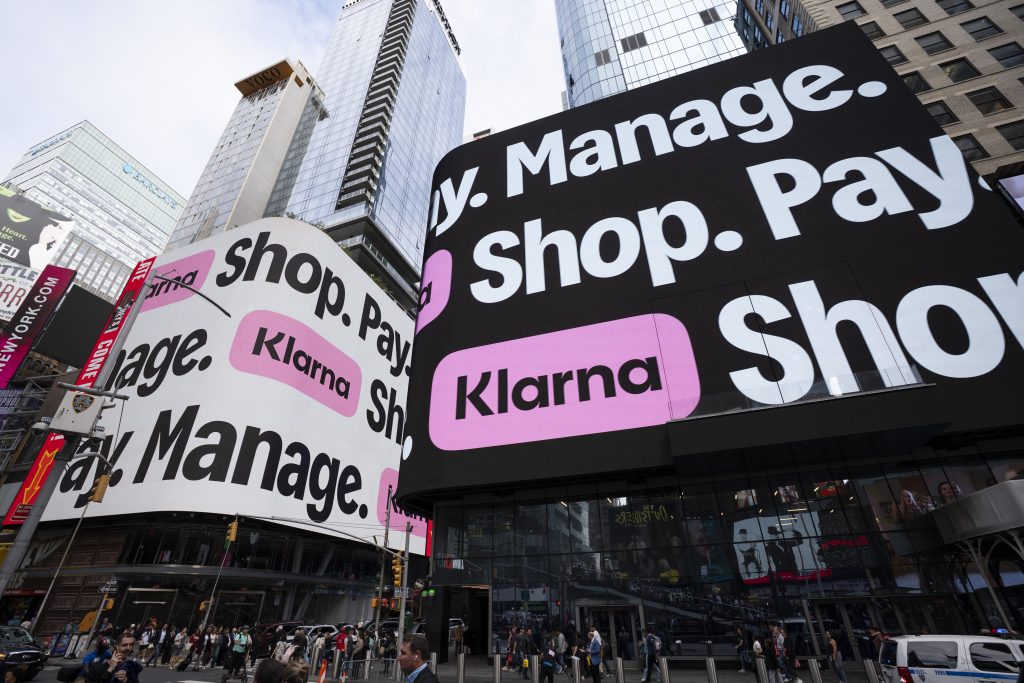
		</button><figcaption class="wp-element-caption">Photo: Klarna</figcaption></figure>


<div class="post-summary bg-gray-100 dark:bg-gray-800 border border-gray-200 dark:border-gray-700 max-w-xl mx-auto p-4 pb-2 rounded-tl rounded-tr">
    <h5 class="wp-block-heading font-jetbrains !text-gray-900 dark:!text-gray-200">TL;DR</h5>
    <div class="summary-content text-gray-900 dark:text-gray-200">
        <ul class="list-disc pl-4 text-left marker:text-gray-900 dark:marker:text-gray-200">
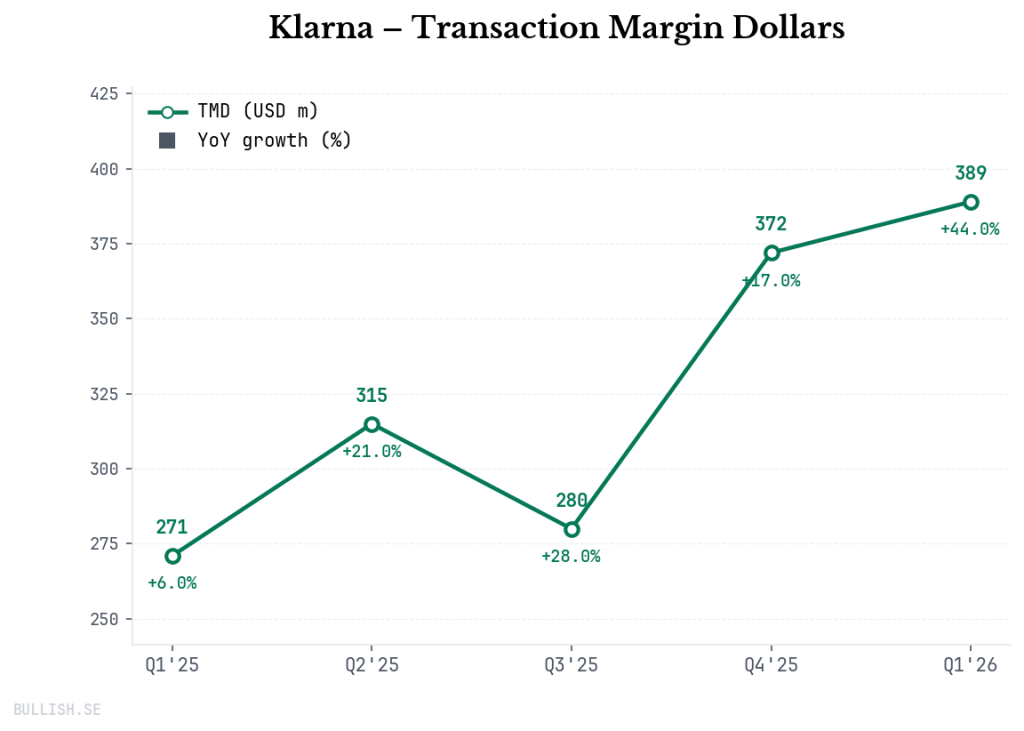
            <li class="font-serif text-sm text-gray-900 dark:text-gray-200">Klarna is a global buy-now-pay-later network that’s trying to become a deposit-funded digital bank, not just a checkout button.</li><li class="font-serif text-sm text-gray-900 dark:text-gray-200">Q1 2026 was the first quarter Klarna posted a positive reported operating profit, and it beat its own guidance range on every single metric — GMV, revenue, transaction margin, and adjusted operating profit.</li><li class="font-serif text-sm text-gray-900 dark:text-gray-200">The real risk isn’t competition from Affirm or Afterpay — it’s that Klarna already missed its own transaction margin guidance once, in Q4 2025, and one clean quarter doesn’t erase that.</li><li class="font-serif text-sm text-gray-900 dark:text-gray-200">Transaction Margin Dollars, the metric management itself says it manages the business to, grew 44 percent year-over-year to $389 million in Q1, after bottoming at 31 percent margin in Q3 2025.</li><li class="font-serif text-sm text-gray-900 dark:text-gray-200">I think Klarna’s discount to Affirm is roughly the right size given a five-quarter track record with one guidance miss in it — not proof the stock is cheap, and not proof it’s a value trap either.</li>        </ul>
    </div>
</div>
<div class="expand-button-content bg-gray-100 dark:bg-gray-800 border border-t-0 border-gray-200 dark:border-gray-700 max-w-xl mb-8 mx-auto rounded-bl rounded-br text-center">
    <button class="expand-button">
        <span class="button-text font-jetbrains uppercase">Show more</span>
        <span class="arrow">&#x2193;</span>
    </button>
</div>


<p class="wp-block-paragraph">Here’s the number that should reframe how you think about this company: transaction margin dollars, the metric Klarna’s own management says it “manages to,” bottomed at a 31 percent margin in the third quarter of 2025 and climbed back to 38 percent by the first quarter of 2026. </p>


<p class="wp-block-paragraph">That’s not a story about a BNPL (Buy Now Pay Later) app losing its edge.</p>


<p class="wp-block-paragraph">That’s a story about a lending business absorbing upfront credit provisions on a fast-growing loan book before the interest income from those same loans has had time to accrue.</p>


<p class="wp-block-paragraph">Whether you believe the recovery is durable or a one-quarter blip is, in my view, the entire debate about this stock right now.</p>


<h3 class="wp-block-heading">Payments App or Bank — And Why That Distinction Matters</h3>


<p class="wp-block-paragraph">Klarna operates as a licensed digital bank headquartered in Stockholm, listed on the NYSE under the ticker KLAR.</p>


<p class="wp-block-paragraph">It runs three consumer products stitched onto a two-sided network of merchants and shoppers: Pay in Full (an everyday debit-like product), Pay Later (an interest-free “charge card equivalent” for medium-sized purchases), and Fair Financing, a longer-duration, interest-bearing installment product that runs three to 48 months.</p>


<p class="wp-block-paragraph">As of Q1 2026, the network spans 1.075 million connected merchants and 119 million active consumers.</p>


<p class="wp-block-paragraph">The company’s own framing — “spend-centric, not lend-centric” — is worth taking seriously rather than dismissing as investor-relations language.</p>


<p class="wp-block-paragraph">Pay Later still makes up 77 percent of gross merchandise volume and turns over more than ten times a year, with an average consumer balance of just $124.</p>


<p class="wp-block-paragraph">That’s a fundamentally different risk profile than a revolving credit card balance averaging roughly $6,900 in the U.S. Klarna re-underwrites essentially every transaction rather than extending an open credit line, and the company points to a through-cycle provision rate of about 0.6 percent across two decades and more than half a trillion dollars originated.</p>


<h3 class="wp-block-heading">The Business Model, In Plain Terms</h3>


<p class="wp-block-paragraph">Klarna makes money three ways: merchant fees on Pay Later transactions, interest income on Fair Financing loans, and — increasingly — gains on sale from selling receivables to institutional investors through forward-flow agreements.</p>


<p class="wp-block-paragraph">That third piece matters more than it might sound. In Q1 2026 alone, Klarna offloaded $1.2 billion of Fair Financing receivables and booked a $57 million gain on sale from it.</p>


<p class="wp-block-paragraph">This is a capital-light growth lever: it moves credit exposure off the balance sheet, accelerates revenue recognition, and frees up capacity to keep originating loans without raising new equity or debt.</p>


<p class="wp-block-paragraph">The funding side is arguably the more interesting structural story. Ninety percent of Klarna’s funding comes from consumer deposits — $12.3 billion as of the end of Q1 2026 — mostly long-term fixed deposits concentrated in Europe. </p>


<p class="wp-block-paragraph">That’s a real cost-of-capital advantage over non-bank BNPL competitors that have to fund receivables through securitization or credit facilities.</p>


<p class="wp-block-paragraph">It also means Klarna’s growth is less exposed to the kind of funding-market stress that can strangle a pure-play lender overnight.</p>


<p class="wp-block-paragraph">Distribution is expanding on the merchant side almost as fast as the network itself: Stripe and Nexi are live and ramping as default-on payment partners, with JPMorgan Payments and Worldpay both scheduled to go live sometime in 2026.</p>


<p class="wp-block-paragraph">That’s a meaningful distribution unlock — Klarna doesn’t have to sell merchants one at a time if it’s the default option inside a payment processor’s stack.</p>


<h3 class="wp-block-heading">Why Transaction Margin Dollars Is the Number That Tells the Real Story</h3>


<p class="wp-block-paragraph">Four metrics matter here, and they don’t all point the same direction if you only look at the headline growth rate.</p>


<p class="wp-block-paragraph"><strong>Revenue</strong> grew 44 percent year-over-year to $1.012 billion in Q1 2026 — the fastest quarterly growth rate in the five quarters of data available.</p>


<p class="wp-block-paragraph">Fair Financing is doing the heavy lifting: interest income rose 56 percent, and the segment’s GMV grew 138 percent year-over-year, now representing 12 percent of total volume.</p>


<p class="wp-block-paragraph"><strong>Transaction Margin Dollars (TMD)</strong> is the number I watch most closely, because it’s the one Klarna’s own CFO explicitly frames as the metric the company manages the business to — not revenue, not GMV. TMD hit $389 million in Q1, up 44 percent year-over-year, but the path to get there wasn’t a straight line.</p>


<p class="wp-block-paragraph">It bottomed at a 31 percent margin in Q3 2025 before recovering to 38 percent in Q1 2026. </p>


<p class="wp-block-paragraph">That dip and recovery is the clearest evidence of what management calls “deferred value creation” — Fair Financing requires upfront credit provisions on new cohorts before the interest income from those loans has time to compound.</p>


<p class="wp-block-paragraph">When growth accelerates faster than expected, margins get squeezed first and expand later.</p>


<p class="wp-block-paragraph"><strong>Provision for credit losses</strong> ran at 0.55 percent of GMV in Q1 2026, essentially flat year-over-year (0.54 percent in Q1 2025) and down from 0.65 percent in Q4 2025.</p>


<p class="wp-block-paragraph">That’s the credit-quality reassurance bulls point to — provisioning didn’t spiral even as Fair Financing volume nearly doubled.</p>


<p class="wp-block-paragraph"><strong>Average revenue per active consumer (ARPAC)</strong> rose 10 percent year-over-year to $32, evidence that Klarna is squeezing more value out of its existing 119 million users rather than relying purely on new-user growth to carry the top line.</p>


<figure class="wp-block-table"><table><thead><tr><th>Metric</th><th>Value</th><th>Context</th></tr></thead><thead><tr><td>Revenue (Q1 2026)</td><td>$1,012m</td><td>+44% YoY, +36% like-for-like</td></tr></thead><tbody><tr><td>Transaction Margin Dollars</td><td>$389m</td><td>+44% YoY; margin recovered from 31% (Q3’25) to 38% (Q1’26)</td></tr><tr><td>Adjusted operating profit</td><td>$68m</td><td>vs. $3m in Q1 2025 – a $65m swing</td></tr><tr><td>Provision for credit losses</td><td>0.55% of GMV</td><td>Flat YoY (0.54%), down from 0.65% in Q4’25</td></tr><tr><td>Active consumers</td><td>119m</td><td>+21% YoY; ARPAC +10% YoY to $32</td></tr></tbody></table></figure>


<h3 class="wp-block-heading">What the Chart Isn’t Telling You About the Margin Recovery</h3>


<p class="wp-block-paragraph">The transaction margin dollar chart looks, at first glance, like a clean recovery story: a dip in Q3 2025, then three straight quarters of acceleration into Q1 2026. </p>


<figure data-wp-context="{&quot;imageId&quot;:&quot;6a960c32381f6&quot;}" data-wp-interactive="core/image" data-wp-key="6a960c32381f6" class="wp-block-image size-large wp-lightbox-container"><img loading="lazy" decoding="async" width="1024" height="731" data-wp-class--hide="state.isContentHidden" data-wp-class--show="state.isContentVisible" data-wp-init="callbacks.setButtonStyles" data-wp-on--click="actions.showLightbox" data-wp-on--load="callbacks.setButtonStyles" data-wp-on--pointerdown="actions.preloadImage" data-wp-on--pointerenter="actions.preloadImageWithDelay" data-wp-on--pointerleave="actions.cancelPreload" data-wp-on-window--resize="callbacks.setButtonStyles" src="https://bullish.se/wp-content/uploads/2026/08/klar-tmd-chart-1024x731.png" alt="" class="wp-image-2368" srcset="https://bullish.se/wp-content/uploads/2026/08/klar-tmd-chart-1024x731.png 1024w, https://bullish.se/wp-content/uploads/2026/08/klar-tmd-chart-300x214.png 300w, https://bullish.se/wp-content/uploads/2026/08/klar-tmd-chart-768x548.png 768w, https://bullish.se/wp-content/uploads/2026/08/klar-tmd-chart.png 1152w" sizes="auto, (max-width: 1024px) 100vw, 1024px" /><button
			class="lightbox-trigger"
			type="button"
			aria-haspopup="dialog"
			data-wp-bind--aria-label="state.thisImage.triggerButtonAriaLabel"
			data-wp-init="callbacks.initTriggerButton"
			data-wp-on--click="actions.showLightbox"
			data-wp-style--right="state.thisImage.buttonRight"
			data-wp-style--top="state.thisImage.buttonTop"
		>
			<svg xmlns="http://www.w3.org/2000/svg" width="12" height="12" fill="none" viewBox="0 0 12 12">
				<path fill="#fff" d="M2 0a2 2 0 0 0-2 2v2h1.5V2a.5.5 0 0 1 .5-.5h2V0H2Zm2 10.5H2a.5.5 0 0 1-.5-.5V8H0v2a2 2 0 0 0 2 2h2v-1.5ZM8 12v-1.5h2a.5.5 0 0 0 .5-.5V8H12v2a2 2 0 0 1-2 2H8Zm2-12a2 2 0 0 1 2 2v2h-1.5V2a.5.5 0 0 0-.5-.5H8V0h2Z" />
			</svg>
		</button><figcaption class="wp-element-caption">Source: Klarna Q1 2026 and Q4 2025 earnings releases. Data as of 2026-08-08.</figcaption></figure>


<p class="wp-block-paragraph">What the line doesn’t show is that this recovery happened at the same time Klarna’s stock fell from a post-IPO high near $57 to a low of $12.06 in March 2026 — a roughly 79 percent peak-to-trough decline. </p>


<p class="wp-block-paragraph">The operating business and the stock price were, for a stretch, moving in almost opposite directions. </p>


<p class="wp-block-paragraph">That’s not necessarily irrational; a lot of that decline predates the Q1 2026 beat and likely reflects the market digesting the Q4 2025 guidance miss along with broader fintech multiple compression. </p>


<p class="wp-block-paragraph">But it does mean the current ~$20 share price already has some of the Q1 recovery priced in, even after a violent round trip.</p>


<h3 class="wp-block-heading">The Market Has Already Priced In the Easy Comparison</h3>


<p class="wp-block-paragraph">The consensus narrative on Klarna right now is roughly: “the BNPL pioneer that finally turned profitable, trading at a steep discount to Affirm because it’s newer to the public markets and still working out the kinks.” </p>


<p class="wp-block-paragraph">That’s directionally true, and it’s also the easy read — which is exactly why I’d push on it a little.</p>


<p class="wp-block-paragraph">Affirm and Klarna posted broadly similar year-over-year growth in their most recent quarters, yet Klarna trades at roughly $7.5 billion versus Affirm’s $24–26 billion, a discount far wider than growth-rate parity alone would explain. </p>


<p class="wp-block-paragraph">Some of that gap is legitimate: Affirm has posted multiple profitable quarters in a row, while Klarna has posted exactly one. </p>


<p class="wp-block-paragraph">Some of it is technical — Klarna’s five-month-old public trading history and 2.08 beta make it a harder position to hold through a drawdown for a lot of institutional mandates, regardless of the underlying fundamentals. </p>


<div class="wp-block-bullish-tracker-tradingview-ticker">
    <tv-single-ticker symbol="NYSE:KLAR"></tv-single-ticker>
</div>


<p class="wp-block-paragraph">But the part of the gap I think is underappreciated is structural: Klarna’s 90 percent deposit-funded balance sheet is a genuine cost-of-capital advantage that neither Affirm nor Afterpay can replicate without becoming a bank themselves. </p>


<p class="wp-block-paragraph">The market is pricing Klarna like a scrappy fintech still proving itself. The funding model says it’s closer to a bank that happens to look like a fintech at checkout.</p>


<h3 class="wp-block-heading">The One Risk Analysts Keep Underweighting</h3>


<p class="wp-block-paragraph">The obvious risk list for Klarna is competitive: Affirm has the Shopify relationship, Block has folded Afterpay directly into Cash App’s 59 million monthly active users, and PayPal is pushing its own pay-later product through sheer distribution scale. </p>


<p class="wp-block-paragraph">Those are real, and worth watching, but they’re also the risks every BNPL earnings call already spends five minutes on.</p>


<p class="wp-block-paragraph">The risk I’d actually worry about is guidance credibility.</p>


<p class="wp-block-paragraph">In Q4 2025, Klarna’s own CFO wrote that transaction margin dollars “came in at $372 million, below our $390-400 million guidance,” attributing the miss to banking-service adoption growing faster than expected. </p>


<p class="wp-block-paragraph">Fair enough — Fair Financing GMV growth genuinely did accelerate to 165 percent year-over-year that quarter, so the explanation is at least consistent with the data. </p>


<p class="wp-block-paragraph">But then Q1 2026 beat the top end of its own guided range on every metric, including adjusted operating profit, which came in at $68 million against a guided ceiling of $35 million — essentially double. </p>


<p class="wp-block-paragraph">That’s not a company dialing in its forecasting; that’s a company whose guidance band has been wrong in both directions within two consecutive quarters. </p>


<p class="wp-block-paragraph">If <a href="https://investors.klarna.com/financials/quarterly-results/" target="_blank" rel="noreferrer noopener">Q2 2026, due August 18</a>, produces a third data point that’s just as far off in either direction, the market should start discounting Klarna’s forward guidance the way it does with genuinely unpredictable early-stage growth names — which would be a real re-rating risk, not a one-quarter story.</p>


<p class="wp-block-paragraph">The second risk worth naming: credit provisions in Fair Financing grew 37 percent year-over-year in Q1 2026, slightly outpacing the 41 percent growth in transaction margin dollars before provisions. </p>


<p class="wp-block-paragraph">It’s a small gap today. If it widens as the loan book scales into a slower macro environment, the margin recovery this article is built around could reverse.</p>


<h3 class="wp-block-heading">Where I Land</h3>


<p class="wp-block-paragraph">Klarna’s Q1 2026 was, by any reasonable reading, a genuinely good quarter — the kind of broad-based beat that would normally do a lot to rebuild credibility after a guidance miss. </p>


<p class="wp-block-paragraph">I think the underlying business is more structurally sound than its stock chart suggests: a deposit-funded balance sheet, a re-underwriting model with a two-decade loss-rate track record, and a transaction margin that’s recovering roughly on the trajectory management laid out. </p>


<p class="wp-block-paragraph">What I’m not willing to do yet is call the guidance miss in Q4 2025 an aberration, because one clean beat afterward doesn’t erase it — it just leaves the sample size at two data points instead of one.</p>


<p class="wp-block-paragraph">What would change my mind in either direction: a second consecutive beat against Q2 2026 guidance would meaningfully raise my confidence that Q4’s miss was noise rather than signal. </p>


<p class="wp-block-paragraph">A second miss — especially one accompanied by rising delinquency in the U.S. Fair Financing cohorts — would tell me the margin recovery story in this article was a favorable quarter dressed up as a trend. </p>


<p class="wp-block-paragraph">Either way, August 18 tells you more about this stock than the last five months of price action did.</p>


<p class="wp-block-paragraph">This is a stock for the investor comfortable underwriting execution risk on a young public company with a genuinely differentiated funding model — not for anyone who needs a multi-quarter track record before they can trust management’s own numbers. </p>


<p class="wp-block-paragraph">If Klarna delivers two more clean quarters against its guidance, the valuation gap to Affirm becomes a much harder case to defend. </p>


<p class="wp-block-paragraph">If it doesn’t, the discount you’re seeing today is the market being right, not early.</p>


<figure class="wp-block-table"><table><thead><tr><th>Field</th><th>Value</th></tr></thead><thead><tr><td>Stock(s)</td><td>Klarna Group plc</td></tr></thead><tbody><tr><td>Ticker</td><td>KLAR</td></tr><tr><td>Exchange / List</td><td>New York Stock Exchange (NYSE)</td></tr><tr><td>Sector</td><td>Fintech / Digital banking – buy-now-pay-later</td></tr><tr><td>Share price</td><td>~$20.13–20.26 (Aug 4–7, 2026)</td></tr><tr><td>Market cap</td><td>~$7.5–7.7 billion</td></tr><tr><td>Dividend</td><td>No</td></tr><tr><td>Next report</td><td>August 18, 2026 (Q2 2026)</td></tr></tbody></table></figure>


<p class="wp-block-paragraph"></p>
]]></content>
		
			</entry>
		<entry>
		<author>
			<name>Bullish</name>
							<uri>https://bullish.se</uri>
						</author>

		<title type="html"><![CDATA[SB1 Sees 90 Percent Upside for Billerud, Lifts Target to SEK 110]]></title>
		<link rel="alternate" type="text/html" href="https://bullish.se/brief/2026/08/11/sb1-sees-90-percent-upside-for-billerud-lifts-target-to-sek-110/" />

		<id>https://bullish.se/brief/2026/08/11//</id>
		<updated>2026-08-11T15:46:20Z</updated>
		<published>2026-08-11T15:46:17Z</published>
		<category scheme="https://bullish.se" term="News Brief" /><category scheme="https://bullish.se" term="Billerud" />
		<summary type="html"><![CDATA[Swedish broker SB1 has raised its price target for forestry group Billerud to 110 SEK from 76.95 SEK, reiterating a buy recommendation, according to EFN. The analysts said the market picture for Billerud has become &#8221;significantly more positive,&#8221; citing a low valuation combined with several near- and long-term catalysts that could give the stock a [&#8230;]]]></summary>

					<content type="html" xml:base="https://bullish.se/brief/2026/08/11/sb1-sees-90-percent-upside-for-billerud-lifts-target-to-sek-110/"><![CDATA[
<p class="wp-block-paragraph">Swedish broker SB1 has raised its price target for forestry group Billerud to 110 SEK from 76.95 SEK, reiterating a buy recommendation, according to <a href="https://efn.se/sb1-90-procents-uppsida-i-billerud" target="_blank" rel="noopener noreferrer">EFN</a>. </p>


<p class="wp-block-paragraph">The analysts said the market picture for Billerud has become &#8221;significantly more positive,&#8221; citing a low valuation combined with several near- and long-term catalysts that could give the stock a potential upside of 90 percent within three years.</p>


<p class="wp-block-paragraph">SB1 pointed to peer SCA&#8217;s announced price increase of 100 euros per tonne for kraftliner cartonboard from September 1, alongside signs from competitors Metsä Board and Mondi of improved demand and pricing for containerboard products.</p>


<p class="wp-block-paragraph">The broker also noted that while Mondi expects higher wood raw material costs in the third quarter due to a tighter Central European market, Billerud should face somewhat lower wood costs in the second half, giving it a clear cost advantage given that wood raw material accounts for 40 percent of operating costs.</p>


<p class="wp-block-paragraph">Longer term, SB1 said Billerud benefits from the structural shift from plastic to fiber-based packaging, while its US graphic paper business continues to generate strong profits. </p>


<p class="wp-block-paragraph">If its 2026-2028 forecasts hold and Billerud deploys its strong balance sheet more aggressively, SB1 estimates the stock could be worth 150 SEK within three years.</p>
]]></content>
		
			</entry>
		<entry>
		<author>
			<name>Bullish</name>
							<uri>https://bullish.se</uri>
						</author>

		<title type="html"><![CDATA[Analysts Can&#8217;t Agree on SKF, and That&#8217;s the Whole Point]]></title>
		<link rel="alternate" type="text/html" href="https://bullish.se/2026/08/10/analysts-cant-agree-on-skf-and-thats-the-whole-point/" />

		<id>https://bullish.se/?p=2273</id>
		<updated>2026-08-05T21:29:44Z</updated>
		<published>2026-08-10T06:00:00Z</published>
		<category scheme="https://bullish.se" term="Company Deep-Dive" /><category scheme="https://bullish.se" term="SKF" />
		<summary type="html"><![CDATA[SKF is the world's largest rolling-bearing maker, and it is currently splitting itself into two companies: a leaner Industrial business and a soon-to-be-listed Automotive spin-off called SKF Vertevo. My take: hold &#8212; the operating story has genuinely improved, but the stock already carries a premium multiple, and the SKF Vertevo listing this autumn is the swing factor nobody has actually priced.]]></summary>

					<content type="html" xml:base="https://bullish.se/2026/08/10/analysts-cant-agree-on-skf-and-thats-the-whole-point/"><![CDATA[
<p class="wp-block-paragraph">Eighteen analysts cover SKF right now. Seven say buy. Seven say hold. Four say sell. </p>


<p class="wp-block-paragraph">Their price targets run from 205 SEK to 305 SEK — a spread of 100 SEK on a stock trading around 263.</p>


<p class="wp-block-paragraph">That&#8217;s not analysts nitpicking a growth rate. That&#8217;s a market that genuinely doesn&#8217;t know what this company is worth, at the exact moment the company itself is trying to answer that question by splitting in two.</p>


<figure data-wp-context="{&quot;imageId&quot;:&quot;6a960c323fe86&quot;}" data-wp-interactive="core/image" data-wp-key="6a960c323fe86" class="wp-block-image size-full wp-lightbox-container"><img loading="lazy" decoding="async" width="800" height="533" data-wp-class--hide="state.isContentHidden" data-wp-class--show="state.isContentVisible" data-wp-init="callbacks.setButtonStyles" data-wp-on--click="actions.showLightbox" data-wp-on--load="callbacks.setButtonStyles" data-wp-on--pointerdown="actions.preloadImage" data-wp-on--pointerenter="actions.preloadImageWithDelay" data-wp-on--pointerleave="actions.cancelPreload" data-wp-on-window--resize="callbacks.setButtonStyles" src="https://bullish.se/wp-content/uploads/2026/08/SKF_factory.jpg" alt="" class="wp-image-2276" srcset="https://bullish.se/wp-content/uploads/2026/08/SKF_factory.jpg 800w, https://bullish.se/wp-content/uploads/2026/08/SKF_factory-300x200.jpg 300w, https://bullish.se/wp-content/uploads/2026/08/SKF_factory-768x512.jpg 768w" sizes="auto, (max-width: 800px) 100vw, 800px" /><button
			class="lightbox-trigger"
			type="button"
			aria-haspopup="dialog"
			data-wp-bind--aria-label="state.thisImage.triggerButtonAriaLabel"
			data-wp-init="callbacks.initTriggerButton"
			data-wp-on--click="actions.showLightbox"
			data-wp-style--right="state.thisImage.buttonRight"
			data-wp-style--top="state.thisImage.buttonTop"
		>
			<svg xmlns="http://www.w3.org/2000/svg" width="12" height="12" fill="none" viewBox="0 0 12 12">
				<path fill="#fff" d="M2 0a2 2 0 0 0-2 2v2h1.5V2a.5.5 0 0 1 .5-.5h2V0H2Zm2 10.5H2a.5.5 0 0 1-.5-.5V8H0v2a2 2 0 0 0 2 2h2v-1.5ZM8 12v-1.5h2a.5.5 0 0 0 .5-.5V8H12v2a2 2 0 0 1-2 2H8Zm2-12a2 2 0 0 1 2 2v2h-1.5V2a.5.5 0 0 0-.5-.5H8V0h2Z" />
			</svg>
		</button><figcaption class="wp-element-caption">Photo: SKF</figcaption></figure>


<p class="wp-block-paragraph">Most quarterly write-ups on SKF right now will tell you the same three things: margins are up, the Automotive business is being spun off, and there&#8217;s a new robotics joint venture in China. </p>


<p class="wp-block-paragraph">All true. </p>


<p class="wp-block-paragraph">None of it explains why Citi and Nordea can look at the same set of numbers and land 48 SEK apart on where the stock should trade.</p>


<div class="post-summary bg-gray-100 dark:bg-gray-800 border border-gray-200 dark:border-gray-700 max-w-xl mx-auto p-4 pb-2 rounded-tl rounded-tr">
    <h5 class="wp-block-heading font-jetbrains !text-gray-900 dark:!text-gray-200">TL;DR</h5>
    <div class="summary-content text-gray-900 dark:text-gray-200">
        <ul class="list-disc pl-4 text-left marker:text-gray-900 dark:marker:text-gray-200">
            <li class="font-serif text-sm text-gray-900 dark:text-gray-200">SKF is the world&#8217;s largest rolling-bearing maker, and it is currently splitting itself into two companies: a leaner Industrial business and a soon-to-be-listed Automotive spin-off called SKF Vertevo.</li><li class="font-serif text-sm text-gray-900 dark:text-gray-200">Adjusted operating margin has climbed for eight straight quarters to 13.9 percent, quietly, while the headline numbers look messy because of separation-related charges.</li><li class="font-serif text-sm text-gray-900 dark:text-gray-200">The real risk isn&#8217;t demand &mdash; it&#8217;s working capital. Net working capital has jumped to 36.4 percent of sales from 31.6 percent a year ago as the split eats cash.</li><li class="font-serif text-sm text-gray-900 dark:text-gray-200">Specialized Industrial Solutions, SKF&#8217;s smallest segment, nearly doubled its margin to 15.2 percent from 10.3 percent, while leverage sits at a comfortable 0.9 times adjusted EBITDA.</li><li class="font-serif text-sm text-gray-900 dark:text-gray-200">My take: hold. The operating story has genuinely improved, but the stock already carries a premium multiple, and the SKF Vertevo listing this autumn is the swing factor nobody has actually priced &mdash; eighteen analysts span targets from 205 to 305 kronor.</li>        </ul>
    </div>
</div>
<div class="expand-button-content bg-gray-100 dark:bg-gray-800 border border-t-0 border-gray-200 dark:border-gray-700 max-w-xl mb-8 mx-auto rounded-bl rounded-br text-center">
    <button class="expand-button">
        <span class="button-text font-jetbrains uppercase">Show more</span>
        <span class="arrow">&#x2193;</span>
    </button>
</div>


<h3 class="wp-block-heading">A Century-Old Bearing Maker Splitting Itself in Two</h3>


<p class="wp-block-paragraph">SKF has been building bearings, seals, and lubrication systems since 1907, and it still holds the top spot in a global rolling-bearing market worth roughly 500 billion SEK — ahead of Schaeffler, Timken, NSK, NTN, and JTEKT, the five companies that round out the industry&#8217;s “big six.” </p>


<p class="wp-block-paragraph">The business runs through roughly 17,000 distributors worldwide and sits deep inside customers&#8217; equipment design cycles, which is a nicer way of saying switching costs are real: once an engineer specs a bearing into a machine tool or a wind turbine gearbox, ripping it out for a cheaper alternative is expensive and risky.</p>


<p class="wp-block-paragraph">What&#8217;s changed is the corporate structure sitting on top of that business. </p>


<p class="wp-block-paragraph">SKF is separating its Automotive division — the part that supplies wheel-end and driveline bearings to carmakers — into a standalone company under the working name SKF Vertevo, with Kerstin Enochsson installed as its CEO and a Stockholm listing targeted for the fourth quarter of 2026, subject to board and shareholder approval.</p>


<p class="wp-block-paragraph">What remains is a tighter Industrial business built around two units: Bearing Solutions, the core franchise, and Specialized Industrial Solutions, which covers aerospace, magnetic bearings, and lubrication systems.</p>


<p class="wp-block-paragraph">There&#8217;s a third, smaller thread worth noting: a July joint venture with China&#8217;s Leaderdrive to build precision transmission components for humanoid robot joints. </p>


<p class="wp-block-paragraph">It&#8217;s early — nowhere near material to the numbers yet — but it&#8217;s the first concrete signal that SKF sees its precision-engineering know-how extending past traditional industrial equipment.</p>


<h3 class="wp-block-heading">Why Free Cash Flow Isn&#8217;t the Story — Margin Discipline Is</h3>


<p class="wp-block-paragraph">Start with the number that&#8217;s been quietly compounding for two years: adjusted operating margin. </p>


<p class="wp-block-paragraph">It bottomed at 11.1 percent in the fourth quarter of 2024 and has climbed almost every quarter since, hitting 13.9 percent in the second quarter of 2026. </p>


<p class="wp-block-paragraph">That&#8217;s not a one-off pricing win. It&#8217;s eight quarters of a trend, and it&#8217;s happening while reported (unadjusted) operating margin actually fell to 9.6 percent in the same period — the gap between the two numbers is entirely separation costs and footprint consolidation charges, roughly 1 billion kronor of them in this quarter alone.</p>


<p class="wp-block-paragraph">Inside that number, Specialized Industrial Solutions is doing the heavy lifting. </p>


<p class="wp-block-paragraph">Its adjusted margin went from 10.3 percent to 15.2 percent year over year, on 8.3 percent organic growth driven by aerospace and magnetic solutions. </p>


<p class="wp-block-paragraph">Bearing Solutions, the bigger and more mature unit, actually saw its margin dip slightly, to 19.2 percent from 20.1 percent — management attributes this to support production being run for Automotive ahead of the split, which is a temporary and self-inflicted drag rather than a competitive one.</p>


<p class="wp-block-paragraph">The number I watch most closely, though, is net working capital as a percentage of trailing twelve-month sales. </p>


<p class="wp-block-paragraph">It&#8217;s risen from 31.6 percent to 36.4 percent over the past year, and it&#8217;s the clearest fingerprint the separation is leaving on the balance sheet. </p>


<p class="wp-block-paragraph">Operating cash flow for the first half of 2026 came in at 1.6 billion SEK, less than half of what it was a year earlier, almost entirely because of this working capital build.</p>


<p class="wp-block-paragraph">Leverage remains fine — net debt sits at 0.9 times adjusted EBITDA — but this is the line item that tells you the spin-off has real, current costs, not just accounting noise.</p>


<figure class="wp-block-table"><table><thead><tr><th>Metric</th><th>Value</th><th>Context</th></tr></thead><thead><tr><td>Adjusted operating margin (Q2 2026)</td><td>13.9%</td><td>Eighth straight quarter of improvement, up from 11.9% in Q3 2024</td></tr></thead><tbody><tr><td>Organic sales growth (Q2 2026)</td><td>+1.4%</td><td>Reversed from -0.2% a year earlier</td></tr><tr><td>SIS segment adjusted margin</td><td>15.2%</td><td>Up from 10.3% a year ago, on 8.3% organic growth</td></tr><tr><td>Net working capital (% of TTM sales)</td><td>36.4%</td><td>Up from 31.6% a year ago; the separation&#8217;s clearest cost</td></tr><tr><td>Net debt / adjusted EBITDA</td><td>0.9x</td><td>Comfortable leverage heading into the Vertevo listing</td></tr></tbody></table></figure>


<h3 class="wp-block-heading">What the Chart Isn&#8217;t Telling You About the Working Capital Story</h3>


<figure data-wp-context="{&quot;imageId&quot;:&quot;6a960c3240f35&quot;}" data-wp-interactive="core/image" data-wp-key="6a960c3240f35" class="wp-block-image size-large wp-lightbox-container"><img loading="lazy" decoding="async" width="1024" height="731" data-wp-class--hide="state.isContentHidden" data-wp-class--show="state.isContentVisible" data-wp-init="callbacks.setButtonStyles" data-wp-on--click="actions.showLightbox" data-wp-on--load="callbacks.setButtonStyles" data-wp-on--pointerdown="actions.preloadImage" data-wp-on--pointerenter="actions.preloadImageWithDelay" data-wp-on--pointerleave="actions.cancelPreload" data-wp-on-window--resize="callbacks.setButtonStyles" src="https://bullish.se/wp-content/uploads/2026/08/SKF-B.ST-AB-SKF-–-Chart-Net-Working-Capital-2026-08-04-1024x731.png" alt="" class="wp-image-2271" srcset="https://bullish.se/wp-content/uploads/2026/08/SKF-B.ST-AB-SKF-–-Chart-Net-Working-Capital-2026-08-04-1024x731.png 1024w, https://bullish.se/wp-content/uploads/2026/08/SKF-B.ST-AB-SKF-–-Chart-Net-Working-Capital-2026-08-04-300x214.png 300w, https://bullish.se/wp-content/uploads/2026/08/SKF-B.ST-AB-SKF-–-Chart-Net-Working-Capital-2026-08-04-768x548.png 768w, https://bullish.se/wp-content/uploads/2026/08/SKF-B.ST-AB-SKF-–-Chart-Net-Working-Capital-2026-08-04.png 1152w" sizes="auto, (max-width: 1024px) 100vw, 1024px" /><button
			class="lightbox-trigger"
			type="button"
			aria-haspopup="dialog"
			data-wp-bind--aria-label="state.thisImage.triggerButtonAriaLabel"
			data-wp-init="callbacks.initTriggerButton"
			data-wp-on--click="actions.showLightbox"
			data-wp-style--right="state.thisImage.buttonRight"
			data-wp-style--top="state.thisImage.buttonTop"
		>
			<svg xmlns="http://www.w3.org/2000/svg" width="12" height="12" fill="none" viewBox="0 0 12 12">
				<path fill="#fff" d="M2 0a2 2 0 0 0-2 2v2h1.5V2a.5.5 0 0 1 .5-.5h2V0H2Zm2 10.5H2a.5.5 0 0 1-.5-.5V8H0v2a2 2 0 0 0 2 2h2v-1.5ZM8 12v-1.5h2a.5.5 0 0 0 .5-.5V8H12v2a2 2 0 0 1-2 2H8Zm2-12a2 2 0 0 1 2 2v2h-1.5V2a.5.5 0 0 0-.5-.5H8V0h2Z" />
			</svg>
		</button><figcaption class="wp-element-caption">Source: SKF Q2 2026 Report (published 17 July 2026), p. 15. Data as of 2026-06-30.</figcaption></figure>


<p class="wp-block-paragraph">The chart above shows net working capital as a percentage of trailing twelve-month sales, by quarter, since the third quarter of 2024. </p>


<p class="wp-block-paragraph">For five straight quarters, that line barely moves — it sits in a tight band between 30 and 32 percent, the kind of number that wouldn&#8217;t earn a second glance in a normal report. </p>


<p class="wp-block-paragraph">Then, in the first quarter of 2026, it breaks upward, and it keeps climbing into the second quarter, hitting 36.4 percent. </p>


<p class="wp-block-paragraph">That&#8217;s not noise.</p>


<p class="wp-block-paragraph">That&#8217;s a step-change coinciding almost exactly with the operational ramp-up of the Automotive separation, and it&#8217;s a cleaner signal than the margin line: this cost is new, it&#8217;s recent, and it isn&#8217;t slowing down yet.</p>


<h3 class="wp-block-heading">The Market Has Already Priced In the Easy Part</h3>


<p class="wp-block-paragraph">Here&#8217;s what I think the market has right: SKF&#8217;s core Industrial business is genuinely better run than it was two years ago, and the stock&#8217;s roughly 31 times trailing earnings — a clear premium to a peer group of NTN, Timken, Nolato, and Volvo trading closer to 25 times — reflects that. </p>


<p class="wp-block-paragraph">Investors have noticed the margin trend and paid up for it.</p>


<div class="wp-block-bullish-tracker-tradingview-ticker">
    <tv-single-ticker symbol="OMXSTO:SKF_B"></tv-single-ticker>
</div>


<p class="wp-block-paragraph">What the market hasn&#8217;t settled is the separation itself. A 100 SEK spread across price targets isn&#8217;t analysts disagreeing about next quarter&#8217;s organic growth rate — it&#8217;s a genuine split of opinion about how SKF Vertevo will be valued once it trades on its own, and about whether the parent company deserves a sum-of-the-parts premium or a conglomerate discount for getting there. </p>


<p class="wp-block-paragraph">JPMorgan, at 230 SEK, is effectively betting the transition costs more than it&#8217;s worth. </p>


<p class="wp-block-paragraph">UBS and Deutsche Bank, both at 280, are betting the opposite.</p>


<p class="wp-block-paragraph">Nobody has SKF Vertevo&#8217;s actual trading multiple to work with yet, because it doesn&#8217;t exist as a listed company. </p>


<p class="wp-block-paragraph">That&#8217;s the variable the market is pricing on guesswork, and it&#8217;s the one that will resolve, one way or another, before year-end.</p>


<h3 class="wp-block-heading">The One Risk That Isn&#8217;t About Demand</h3>


<p class="wp-block-paragraph">The obvious risk with any industrial bearing maker is cyclical demand, and SKF has some of that — Automotive&#8217;s organic sales fell 1.4 percent in the second quarter, dragged down by weak European volumes. </p>


<p class="wp-block-paragraph">But that&#8217;s not the risk I&#8217;d actually lose sleep over, because it&#8217;s already visible in the numbers and largely priced.</p>


<p class="wp-block-paragraph">The first real risk is execution on the Vertevo listing itself. </p>


<p class="wp-block-paragraph">“Subject to board and shareholder approval” is doing real work in that sentence — if the listing slips into 2027 or gets pulled entirely, the working capital drag continues without the payoff that&#8217;s supposed to justify it.</p>


<p class="wp-block-paragraph">The second is that working capital trend. </p>


<p class="wp-block-paragraph">If NWC keeps climbing past 36 percent of sales into the third quarter, it stops looking like a one-time separation cost and starts looking like a structural change in how the business converts profit into cash — a much less forgivable problem.</p>


<p class="wp-block-paragraph">The third is more subtle: SIS&#8217;s margin expansion is impressive, but it&#8217;s a small segment riding aerospace and magnetics strength. </p>


<p class="wp-block-paragraph">If that growth cools while Bearing Solutions is still absorbing support-production costs for Automotive, the group margin trend could stall right when the market is watching most closely.</p>


<h3 class="wp-block-heading">The Verdict</h3>


<p class="wp-block-paragraph">I&#8217;d call SKF a hold, not because the operating story is bad — it&#8217;s genuinely improving — but because the stock has already been rewarded for the part of the thesis that&#8217;s easy to see, while the part that will actually move the needle is still unresolved. </p>


<p class="wp-block-paragraph">Three things would change my mind:</p>


<ul class="wp-block-list">
<li>A confirmed listing date and structure for SKF Vertevo, ideally with an indicative valuation range attached</li>


<li>Net working capital stabilizing or reversing in the third-quarter report</li>


<li>Evidence that SIS&#8217;s margin gains are holding even as support production for Automotive winds down</li>
</ul>


<p class="wp-block-paragraph">This is a stock for the investor who&#8217;s comfortable owning event-driven uncertainty for a specific catalyst — the Vertevo listing — rather than someone looking for a clean industrial compounder to hold and forget.</p>


<p class="wp-block-paragraph">It&#8217;s the wrong fit if you need a settled valuation story today: until the spin-off prices, you&#8217;re underwriting two businesses through the multiple of one, and the market&#8217;s own analysts can&#8217;t agree on what that&#8217;s worth.</p>


<figure class="wp-block-table"><table><thead><tr><th>Field</th><th>Value</th></tr></thead><thead><tr><td>Stock(s)</td><td>SKF A / SKF B</td></tr></thead><tbody><tr><td>Ticker</td><td>SKF A.ST / SKF B.ST</td></tr><tr><td>Exchange / List</td><td>Nasdaq Stockholm, Large Cap</td></tr><tr><td>Sector</td><td>Industrials – bearings and industrial components</td></tr><tr><td>Share price</td><td>SEK 262.7 (July 16, 2026)</td></tr><tr><td>Market cap</td><td>Approximately SEK 119.8 billion</td></tr><tr><td>Dividend</td><td>Yes – SEK 7.75/share (yield approximately 3.0 percent)</td></tr><tr><td>Next report</td><td>October 21, 2026 (Q3 2026)</td></tr></tbody></table></figure>


<p class="wp-block-paragraph"></p>
]]></content>
		
			</entry>
	</feed>