Analysts Can’t Agree on SKF, and That’s the Whole Point

Eighteen analysts cover SKF right now. Seven say buy. Seven say hold. Four say sell.
Their price targets run from 205 SEK to 305 SEK — a spread of 100 SEK on a stock trading around 263.
That’s not analysts nitpicking a growth rate. That’s a market that genuinely doesn’t know what this company is worth, at the exact moment the company itself is trying to answer that question by splitting in two.
Most quarterly write-ups on SKF right now will tell you the same three things: margins are up, the Automotive business is being spun off, and there’s a new robotics joint venture in China.
All true.
None of it explains why Citi and Nordea can look at the same set of numbers and land 48 SEK apart on where the stock should trade.
TL;DR
- SKF is the world’s largest rolling-bearing maker, and it is currently splitting itself into two companies: a leaner Industrial business and a soon-to-be-listed Automotive spin-off called SKF Vertevo.
- Adjusted operating margin has climbed for eight straight quarters to 13.9 percent, quietly, while the headline numbers look messy because of separation-related charges.
- The real risk isn’t demand — it’s working capital. Net working capital has jumped to 36.4 percent of sales from 31.6 percent a year ago as the split eats cash.
- Specialized Industrial Solutions, SKF’s smallest segment, nearly doubled its margin to 15.2 percent from 10.3 percent, while leverage sits at a comfortable 0.9 times adjusted EBITDA.
- My take: hold. The operating story has genuinely improved, but the stock already carries a premium multiple, and the SKF Vertevo listing this autumn is the swing factor nobody has actually priced — eighteen analysts span targets from 205 to 305 kronor.
A Century-Old Bearing Maker Splitting Itself in Two
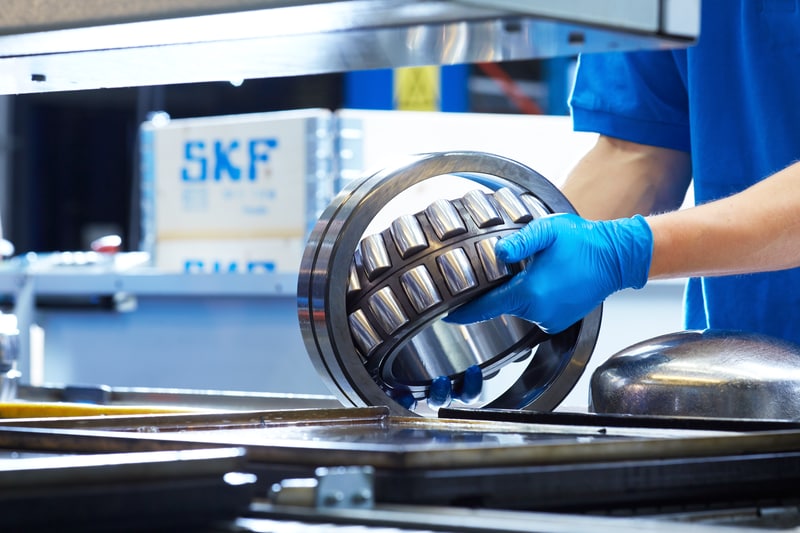
SKF has been building bearings, seals, and lubrication systems since 1907, and it still holds the top spot in a global rolling-bearing market worth roughly 500 billion SEK — ahead of Schaeffler, Timken, NSK, NTN, and JTEKT, the five companies that round out the industry’s “big six.”
The business runs through roughly 17,000 distributors worldwide and sits deep inside customers’ equipment design cycles, which is a nicer way of saying switching costs are real: once an engineer specs a bearing into a machine tool or a wind turbine gearbox, ripping it out for a cheaper alternative is expensive and risky.
What’s changed is the corporate structure sitting on top of that business.
SKF is separating its Automotive division — the part that supplies wheel-end and driveline bearings to carmakers — into a standalone company under the working name SKF Vertevo, with Kerstin Enochsson installed as its CEO and a Stockholm listing targeted for the fourth quarter of 2026, subject to board and shareholder approval.
What remains is a tighter Industrial business built around two units: Bearing Solutions, the core franchise, and Specialized Industrial Solutions, which covers aerospace, magnetic bearings, and lubrication systems.
There’s a third, smaller thread worth noting: a July joint venture with China’s Leaderdrive to build precision transmission components for humanoid robot joints.
It’s early — nowhere near material to the numbers yet — but it’s the first concrete signal that SKF sees its precision-engineering know-how extending past traditional industrial equipment.
Why Free Cash Flow Isn’t the Story — Margin Discipline Is
Start with the number that’s been quietly compounding for two years: adjusted operating margin.
It bottomed at 11.1 percent in the fourth quarter of 2024 and has climbed almost every quarter since, hitting 13.9 percent in the second quarter of 2026.
That’s not a one-off pricing win. It’s eight quarters of a trend, and it’s happening while reported (unadjusted) operating margin actually fell to 9.6 percent in the same period — the gap between the two numbers is entirely separation costs and footprint consolidation charges, roughly 1 billion kronor of them in this quarter alone.
Inside that number, Specialized Industrial Solutions is doing the heavy lifting.
Its adjusted margin went from 10.3 percent to 15.2 percent year over year, on 8.3 percent organic growth driven by aerospace and magnetic solutions.
Bearing Solutions, the bigger and more mature unit, actually saw its margin dip slightly, to 19.2 percent from 20.1 percent — management attributes this to support production being run for Automotive ahead of the split, which is a temporary and self-inflicted drag rather than a competitive one.
The number I watch most closely, though, is net working capital as a percentage of trailing twelve-month sales.
It’s risen from 31.6 percent to 36.4 percent over the past year, and it’s the clearest fingerprint the separation is leaving on the balance sheet.
Operating cash flow for the first half of 2026 came in at 1.6 billion SEK, less than half of what it was a year earlier, almost entirely because of this working capital build.
Leverage remains fine — net debt sits at 0.9 times adjusted EBITDA — but this is the line item that tells you the spin-off has real, current costs, not just accounting noise.
| Metric | Value | Context |
|---|---|---|
| Adjusted operating margin (Q2 2026) | 13.9% | Eighth straight quarter of improvement, up from 11.9% in Q3 2024 |
| Organic sales growth (Q2 2026) | +1.4% | Reversed from -0.2% a year earlier |
| SIS segment adjusted margin | 15.2% | Up from 10.3% a year ago, on 8.3% organic growth |
| Net working capital (% of TTM sales) | 36.4% | Up from 31.6% a year ago; the separation’s clearest cost |
| Net debt / adjusted EBITDA | 0.9x | Comfortable leverage heading into the Vertevo listing |
What the Chart Isn’t Telling You About the Working Capital Story
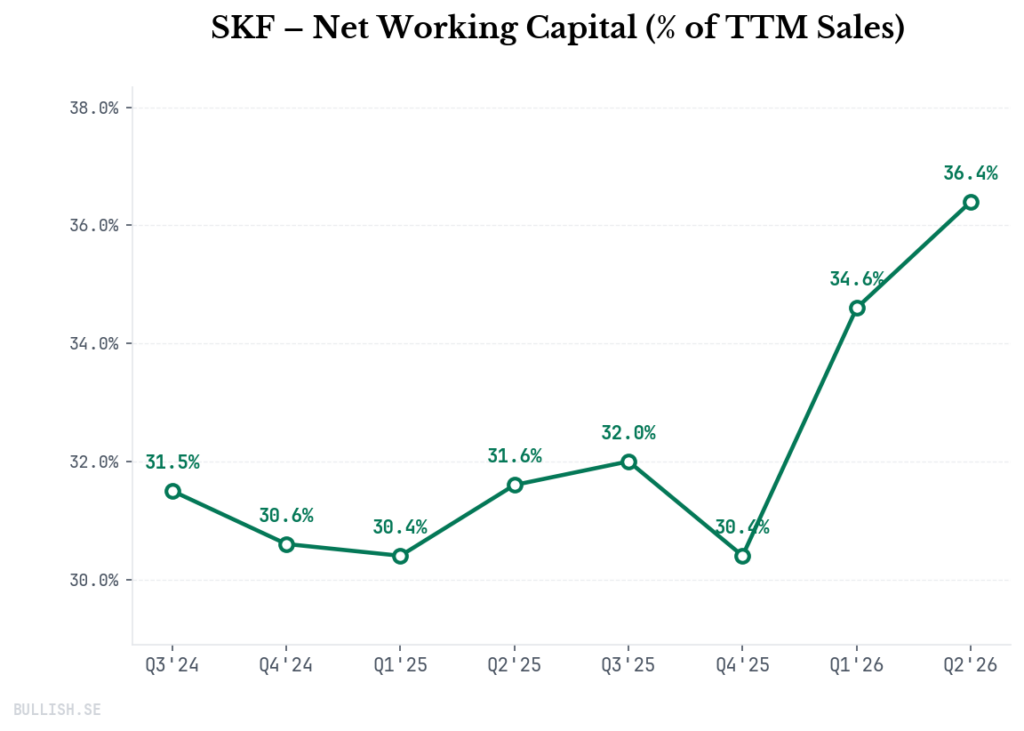
The chart above shows net working capital as a percentage of trailing twelve-month sales, by quarter, since the third quarter of 2024.
For five straight quarters, that line barely moves — it sits in a tight band between 30 and 32 percent, the kind of number that wouldn’t earn a second glance in a normal report.
Then, in the first quarter of 2026, it breaks upward, and it keeps climbing into the second quarter, hitting 36.4 percent.
That’s not noise.
That’s a step-change coinciding almost exactly with the operational ramp-up of the Automotive separation, and it’s a cleaner signal than the margin line: this cost is new, it’s recent, and it isn’t slowing down yet.
The Market Has Already Priced In the Easy Part
Here’s what I think the market has right: SKF’s core Industrial business is genuinely better run than it was two years ago, and the stock’s roughly 31 times trailing earnings — a clear premium to a peer group of NTN, Timken, Nolato, and Volvo trading closer to 25 times — reflects that.
Investors have noticed the margin trend and paid up for it.
What the market hasn’t settled is the separation itself. A 100 SEK spread across price targets isn’t analysts disagreeing about next quarter’s organic growth rate — it’s a genuine split of opinion about how SKF Vertevo will be valued once it trades on its own, and about whether the parent company deserves a sum-of-the-parts premium or a conglomerate discount for getting there.
JPMorgan, at 230 SEK, is effectively betting the transition costs more than it’s worth.
UBS and Deutsche Bank, both at 280, are betting the opposite.
Nobody has SKF Vertevo’s actual trading multiple to work with yet, because it doesn’t exist as a listed company.
That’s the variable the market is pricing on guesswork, and it’s the one that will resolve, one way or another, before year-end.
The One Risk That Isn’t About Demand
The obvious risk with any industrial bearing maker is cyclical demand, and SKF has some of that — Automotive’s organic sales fell 1.4 percent in the second quarter, dragged down by weak European volumes.
But that’s not the risk I’d actually lose sleep over, because it’s already visible in the numbers and largely priced.
The first real risk is execution on the Vertevo listing itself.
“Subject to board and shareholder approval” is doing real work in that sentence — if the listing slips into 2027 or gets pulled entirely, the working capital drag continues without the payoff that’s supposed to justify it.
The second is that working capital trend.
If NWC keeps climbing past 36 percent of sales into the third quarter, it stops looking like a one-time separation cost and starts looking like a structural change in how the business converts profit into cash — a much less forgivable problem.
The third is more subtle: SIS’s margin expansion is impressive, but it’s a small segment riding aerospace and magnetics strength.
If that growth cools while Bearing Solutions is still absorbing support-production costs for Automotive, the group margin trend could stall right when the market is watching most closely.
The Verdict
I’d call SKF a hold, not because the operating story is bad — it’s genuinely improving — but because the stock has already been rewarded for the part of the thesis that’s easy to see, while the part that will actually move the needle is still unresolved.
Three things would change my mind:
- A confirmed listing date and structure for SKF Vertevo, ideally with an indicative valuation range attached
- Net working capital stabilizing or reversing in the third-quarter report
- Evidence that SIS’s margin gains are holding even as support production for Automotive winds down
This is a stock for the investor who’s comfortable owning event-driven uncertainty for a specific catalyst — the Vertevo listing — rather than someone looking for a clean industrial compounder to hold and forget.
It’s the wrong fit if you need a settled valuation story today: until the spin-off prices, you’re underwriting two businesses through the multiple of one, and the market’s own analysts can’t agree on what that’s worth.
| Field | Value |
|---|---|
| Stock(s) | SKF A / SKF B |
| Ticker | SKF A.ST / SKF B.ST |
| Exchange / List | Nasdaq Stockholm, Large Cap |
| Sector | Industrials – bearings and industrial components |
| Share price | SEK 262.7 (July 16, 2026) |
| Market cap | Approximately SEK 119.8 billion |
| Dividend | Yes – SEK 7.75/share (yield approximately 3.0 percent) |
| Next report | October 21, 2026 (Q3 2026) |
Disclosure: At the time of publication, the author holds a position in the securities discussed in this article.