Spotify’s Margin Story Just Got Harder to Ignore

Every subscription business eventually has to answer an uncomfortable question: is the growth story actually a margin story wearing a disguise?
Spotify spent the better part of two decades letting investors debate whether it could ever be genuinely profitable. That debate is now effectively over, and most of the commentary since the second-quarter print has focused on the wrong headline number.

The 300 million Premium subscriber milestone got the attention. The number that should have gotten more of it is 33.4 percent — Spotify’s gross margin in the quarter, a record, and the sixth straight quarter of expansion.
Reaching 300 million subscribers is a nice round number for a press release. Six consecutive quarters of margin expansion is a pattern, and patterns are what separate a story from a thesis.
TL;DR
- Spotify is the freemium audio marketplace that finally figured out how to convert scale into cash, not just users.
- Gross margin has expanded for six consecutive quarters, hitting a record 33.4 percent in Q2 2026, and the company just wiped out its only meaningful debt.
- The real risk isn’t Apple or Amazon — it’s that roughly 72 percent of everything streamed on the platform runs through licensing deals with three record labels that Spotify doesn’t fully control.
- Free cash flow on a trailing-twelve-month basis has grown from 209 million euros in September 2023 to 3.26 billion euros today, a nearly sixteen-fold increase in under three years.
- My take: this is a buy, but not a screaming one — the operating story has clearly turned, yet the stock’s valuation already assumes several more years of exactly this kind of execution.
What Spotify Actually Sells
Spotify runs a two-sided marketplace, not just a streaming app. On one side sit 777 million monthly active users, split between 300 million paying Premium subscribers and 494 million ad-supported listeners who cost the company almost nothing to serve beyond bandwidth and licensing.
On the other side sit the rights holders — record labels, podcasters, audiobook publishers — who need Spotify’s distribution and, increasingly, its marketing tools and analytics to reach an audience they couldn’t otherwise assemble on their own.
The Premium side is straightforward: subscribers pay a monthly fee across Individual, Family, Duo, and Student tiers, and Spotify keeps the difference between that fee and what it owes in royalties.
The Ad-Supported side monetizes the free tier through display, audio, and video advertising, increasingly sold through automated exchanges rather than direct sales teams — a shift that matters because programmatic buying scales without proportional headcount growth.
Together, these segments generated 4.78 billion euros in the second quarter, up 14 percent year over year.
What makes the model interesting isn’t the subscription mechanic itself — that’s Netflix’s playbook too.
It’s that Spotify doesn’t own the content it sells. Roughly 72 percent of everything streamed runs through licensing agreements with Universal Music Group, Sony Music Entertainment, and Warner Music Group, plus Merlin for independent labels.
That’s the defining structural feature of this business: Spotify controls distribution and discovery, but not the underlying product.
Every dollar of gross margin expansion has come from growing revenue faster than a royalty base Spotify can’t unilaterally renegotiate downward.
The company is now pushing into adjacent marketplace products that widen the moat a little further from pure distribution.
Audiobooks+ add-on tiers, a Reserved concert-ticket program built with Live Nation that’s already moved nearly 100,000 tickets, and AI-generated Personal Podcasts are all attempts to build revenue streams where Spotify captures more value per user without needing new licensing leverage over the majors.
The Numbers That Aren’t on the Press Release
Start with the one everyone quoted: gross margin at 33.4 percent, up 193 basis points year over year.
That’s a record, and it’s not a one-quarter fluke — margin has now expanded in Premium (34.9 percent, up 174 basis points) and Ad-Supported (19.1 percent, up 179 basis points) simultaneously, which tells you the improvement isn’t just a mix shift toward the higher-margin subscription business.
Both halves of the company are getting more efficient at the same time.
Operating income tells a similar story but with more drama: 655 million euros in the quarter, up 61 percent year over year, against an operating loss of 446 million euros for the entirety of 2023.
That’s not incremental improvement — that’s a business that crossed a structural threshold.
Then there’s the balance sheet move that got comparatively little attention: Spotify fully repaid its Exchangeable Notes — 1.3 billion euros — during the first quarter of 2026.
The company now sits in a net cash position, with roughly 10.5 billion euros in cash, short-term, and long-term investments and effectively zero financial debt.
Combine that with accelerating buybacks — 662 million dollars repurchased year-to-date through early August, up 30 percent from the same period a year ago — and you have a company that’s gone from cash-burning growth story to disciplined capital allocator in under three years.
Premium ARPU is the one number that doesn’t fit the clean narrative. It actually fell 1 percent for full-year 2025, to 4.63 euros, as currency headwinds and product mix offset price increases.
Worth watching, because ARPU softness is exactly the kind of thing that can quietly erode margin gains if it persists.
But the number I watch most closely is free cash flow on a trailing-twelve-month basis, because it strips out the noise in quarterly operating income — including the currency-linked ”Social Charges” swings the company itself flags as volatile — and shows the underlying cash generation trend without distortion.
| Metric | Value | Context |
|---|---|---|
| Gross margin (Q2 2026) | 33.4% | Record high, up 193 bps YoY, sixth straight quarter of expansion |
| Operating income (Q2 2026) | €655M | Up 61% YoY; vs. a full-year operating loss of €446M in 2023 |
| Free cash flow (LTM) | €3,261M | Up from €209M in September 2023 |
| Premium subscribers | 300M | +9% YoY; crossed the 300M milestone this quarter |
| Net financial debt | None | Exchangeable Notes fully repaid in Q1 2026; net cash position |
What the Chart Isn’t Telling You About the Margin Story
The trailing-twelve-month free cash flow chart above looks almost too clean — a nearly uninterrupted climb from 209 million euros to 3.26 billion euros in under three years.
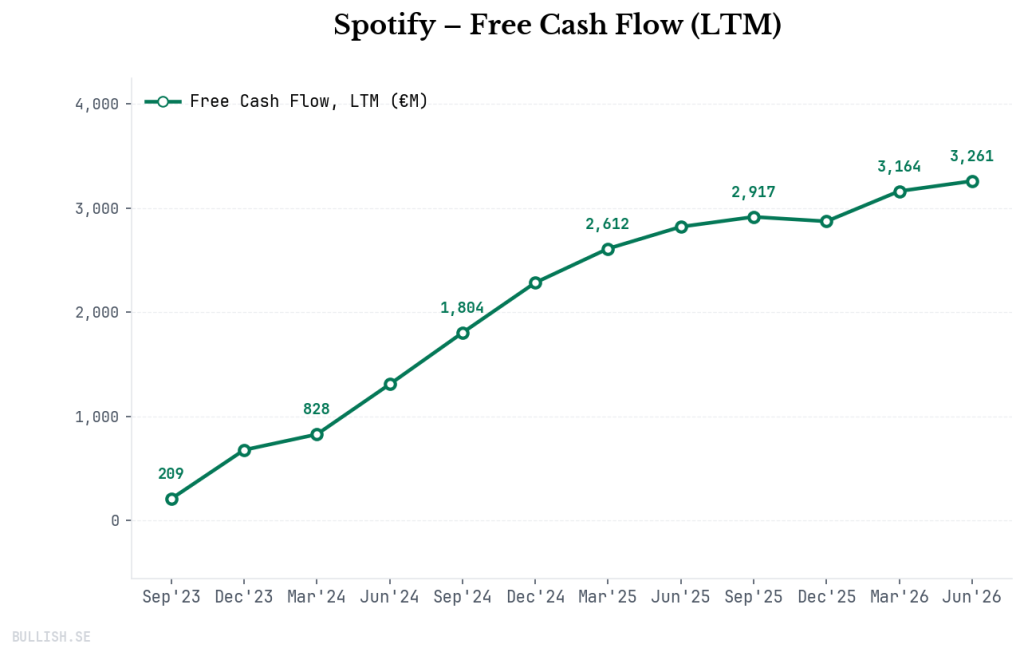
What it doesn’t show is how lumpy the underlying quarters were to get there: capital expenditures remain minimal (21 million euros in the latest quarter, under half a percent of revenue), so this isn’t a capex story.
It’s almost entirely an operating income and working capital story, which means the trend is more durable than a chart driven by one-off asset sales or tax credits would be.
The flattening between September and December 2025 — 2,917 million to 2,874 million euros — is the only real pause in an otherwise relentless line, and it lines up with typical seasonal working capital timing rather than any deterioration in the underlying business.
The Market Has Already Priced In the Easy Part
Wall Street’s read on Spotify right now is straightforward: analyst consensus leans heavily bullish, with buy ratings dominating across every source I checked
, and average price targets clustered somewhere between 585 and 620 dollars depending on which aggregator you trust — a meaningful spread on its own, worth noting.
That’s roughly 20 to 25 percent upside from current levels.
Here’s my pushback: the market isn’t wrong that the margin story is real, but a forward P/E above 30 times and an EV/EBITDA near 21 times already assumes this expansion continues for several more years without a hiccup.
Compare that to SiriusXM, trading at roughly 7.7 times EV/EBITDA — a genuinely unfair comparison given SiriusXM is a structurally shrinking satellite radio business, but it’s illustrative of just how much growth and margin durability the market is underwriting in Spotify’s multiple.
The easy part — proving the business could be profitable at all — is done and priced in.
The harder part, sustaining double-digit margin gains against a royalty structure Spotify doesn’t control, is the actual bet investors are making now.
The One Risk Analysts Keep Underweighting
Three risks are worth real attention here, and only one of them gets proportional coverage.
The first, and the one everyone talks about, is competition from Apple, Amazon, and YouTube Music — companies that can subsidize a streaming product with hardware or retail margins Spotify doesn’t have.
It’s real, but Spotify has weathered it for a decade without losing its lead in monthly active users, so I’d argue this risk is already reasonably well understood and priced.
The second is governance, and it’s genuinely underdiscussed.
Founders Daniel Ek and Martin Lorentzon together control 69.3 percent of voting power through a beneficiary-certificate structure, despite owning only around 23 percent of the economic shares.
If the newly installed co-CEO structure — Alex Norström and Gustav Söderström, in the roles since January 2026 — runs into strategic disagreement with outside shareholders, there’s essentially no mechanism for those shareholders to force a change.
This isn’t a near-term catalyst, but it’s a standing feature of the risk profile that gets far less airtime than it deserves relative to its potential impact.
The third, and the one I think matters most financially, is licensing concentration.
Spotify’s entire gross margin story depends on growing revenue faster than royalty costs set largely by three record labels with ”most favored nation” clauses in their contracts.
If any of Universal, Sony, or Warner extracts materially worse terms at the next renewal — and these are multi-year, not automatically renewable agreements — the margin expansion that’s driving this entire investment case could stall or reverse in a way that has nothing to do with subscriber growth or competitive pressure.
The Verdict
I think Spotify has genuinely earned its re-rating from cash-burning growth story to disciplined, profitable platform business — the margin data across six straight quarters is too consistent to dismiss as noise.
But the stock isn’t cheap anymore, and at a forward P/E above 30 times, there’s limited room for anything to go wrong on the licensing side or in Premium ARPU before the multiple starts to look like the problem rather than the opportunity.
What would change my mind in either direction:
- A Q3 2026 print that misses guidance on gross margin as well as subscriber adds — not just one metric — would suggest the expansion is decelerating faster than the market expects.
- Any public signal of tension in the upcoming licensing renewal cycle with Universal, Sony, or Warner would be the single biggest threat to the entire margin thesis.
- Continued ARPU weakness beyond currency effects into 2026 would be the clearest sign that pricing power is softer than the headline numbers suggest.
This is a stock for the investor who wants exposure to a genuine, multi-year platform margin story with a fortress balance sheet behind it — not for anyone looking for a cheap entry point.
If you’re underwriting Spotify here, you’re underwriting continued flawless execution against a licensing structure the company doesn’t fully control, and paying a growth-stock multiple for the privilege.
| Field | Value |
|---|---|
| Stock(s) | Spotify Technology S.A. |
| Ticker | SPOT |
| Exchange / List | NYSE, Large Cap |
| Sector | Audio streaming / digital media |
| Share price | $490.28 (August 7, 2026) |
| Market cap | ~$100–101 billion |
| Dividend | No |
| Next report | Approximately October 27–November 3, 2026 (exact date varies by source) |