While Żabka Just Got Bought Out Near Its Highs, Dino Is Sitting Near a Four-Year Low

On the same day this summer that a Canadian convenience-store giant agreed to pay roughly $8.6 billion for Żabka Group — Poland’s dominant corner-shop chain — taking it private at a price near its 52-week high, another Polish grocery retailer was trading close to its lowest level in four years.
Same country, same sector, same broad consumer backdrop.
Wildly different stories.
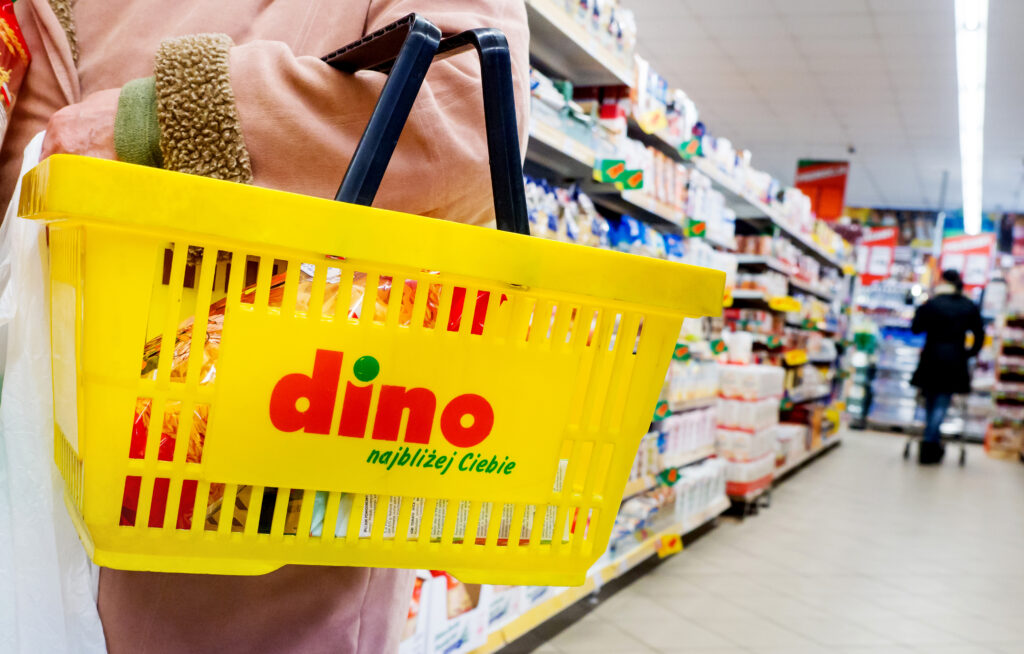
That contrast is the reason to look at Dino Polska right now.
Not because it’s about to be bought — its founder controls just over half the company and shows no sign of wanting to sell — but because the gap between Żabka’s ending and Dino’s current chart tells you something concrete about what the market actually rewards in this sector, and what it’s still waiting to see from Dino before it forgives the stock.
TL;DR
- Dino Polska runs a chain of small-format supermarkets built for towns too small for the big chains to bother with – and it’s still opening roughly a store a day.
- The bull case hasn’t broken: like-for-like sales grew 4.4 percent in the first quarter, the balance sheet is essentially debt-free, and the store rollout is on track for another double-digit year.
- The real risk isn’t the growth story – it’s that margins have now fallen for five straight reporting periods in a row, and management’s own explanation (a deliberate volume-over-margin pricing call) has yet to be proven right by the numbers.
- EBITDA margin has slid from 7.9 percent in FY2024 to 6.7 percent in the first quarter of 2026, even as revenue kept growing in the mid-teens – a divergence that’s rarely a good sign this far into a cycle.
- I’m not bearish, but I wouldn’t buy this dip yet: Dino needs to show margin stabilization before the current valuation discount closes, and Żabka’s buyout – at a premium of less than 10 percent to a stock already near its highs – is a reminder of how differently the market treats proven execution versus a story still under review.
A Retailer Most International Investors Have Never Heard Of
Dino Polska (WSE: DNP) runs roughly 3,100 mid-sized supermarkets across Poland, concentrated in smaller towns and the edges of bigger cities — the geography most large chains have historically underserved.
The company trades on the Warsaw Stock Exchange at around 31.8 zloty, putting its market capitalization near 31 billion zloty. It’s part of the WIG30 and, unlike Żabka, has no takeover speculation attached to it.
Why a Boring Store Format Is the Whole Point
Dino’s model is almost deliberately unglamorous. Every store looks the same: about 400 square meters, roughly 5,000 products, a meat counter supplied by the company’s own processing plant, Agro-Rydzyna, rather than a third-party supplier.
Twelve distribution centers feed the network, and a thirteenth is now under construction in Zawiercie.
The economics work because the format is cheap to replicate. A standardized store with a predictable footprint is a repeatable unit, not a bespoke real-estate project — which is exactly why Dino has been able to grow its store count by 40 percent over three years without loading up on debt to do it.
Net debt sits at roughly 0.1 times EBITDA, a number most retailers would consider a rounding error rather than a leverage ratio.
The growth plan for 2026 is explicit: management has guided to double-digit percentage growth in new store openings and roughly 2.5 billion zloty of capital expenditure, split between continued rollout and logistics capacity — including that new Zawiercie distribution center and a planned 250–300 million zloty investment in reverse vending machines for bottle and can recycling.
None of this is opportunistic. It’s the same playbook Dino has run for years, just at a larger scale.
The Margin Line That’s Quietly Doing All the Work
Start with the number that actually explains the stock’s recent behavior: like-for-like sales growth hit 4.4 percent in the first quarter of 2026, up sharply from just 0.5 percent a year earlier.
That’s a real acceleration in the existing store base, not just new units padding the topline. Total revenue grew 14.8 percent year-on-year in the same quarter, and total store count rose to roughly 3,100.
Here’s where it gets less comfortable.
EBITDA margin has now declined in every recent comparable period I can check: 7.9 percent in FY2024, 7.6 percent in FY2025, and down to 6.7 percent in the first quarter of 2026 versus 7.2 percent a year before.
Management’s own explanation is that this is deliberate — a pricing policy aimed at maximizing volume in a period of outright food deflation in Poland, plus some weather-related cost noise.
That’s a defensible strategy.
It’s also, notably, not yet a proven one: net profit was essentially flat year-on-year in the first quarter despite that mid-teens revenue growth, which is what operating deleverage looks like on a P&L.
The number I watch most closely is that EBITDA margin line, because it’s the one variable standing between “temporary strategic tradeoff” and “structural erosion.”
A retailer that keeps growing revenue while margin keeps compressing isn’t automatically in trouble — but it needs to show the compression stopping within a couple of quarters, or the market will stop giving it the benefit of the doubt.
| Metric | Value | Context |
|---|---|---|
| Like-for-like sales growth (Q1 2026) | 4.4% | Up from just 0.5% in Q1 2025 |
| EBITDA margin (Q1 2026) | 6.7% | Down from 7.2% a year earlier and 7.9% in FY2024 |
| Revenue growth (Q1 2026, YoY) | +14.8% | Driven by both new stores and like-for-like growth |
| Net debt / EBITDA | 0.1x | Among the lowest leverage ratios in European retail |
| Store count | ~3,100 | Up 40% over the past three years |
A Four-Year Low for a Stock That Rarely Moves This Much
The chart tells a blunter story than the fundamentals alone.
Dino traded near 50 zloty earlier this year before a brutal single-session move: shares fell roughly 16 to 18 percent after the FY2025 fourth-quarter numbers landed in late March, missing consensus EBITDA estimates by a wide margin (613.5 million zloty reported against roughly 721 million expected).
That was the trigger, not the whole story — Citi downgraded the stock to Neutral shortly after, and a second leg lower came over the summer when the pace of new store openings was read by some as evidence the growth engine itself was cooling, not just the margin.
The stock now sits near a four-year low, roughly 30 to 32 zloty, having lost close to 40 percent of its value over the past twelve months.
Beta on the name is unusually low — around 0.5 — which tells you this isn’t a stock that normally whipsaws with the broader market. When a low-beta defensive name moves this much, the cause is company-specific, and in this case it clearly is.
The Market Priced In a Broken Growth Story — I’m Not Sure That’s Right
The dominant narrative right now is straightforward: the growth story cracked.
Analysts who once paid up for Dino’s compounding store count are now asking whether that growth is coming at the expense of unit economics, and whether a slower store-opening cadence signals the easy runway is narrowing.
I think that narrative is directionally right but probably overextended on the growth side specifically.
Store openings running at a “teens” percentage clip and a 4.4 percent like-for-like number are not the profile of a company that’s run out of room — they’re the profile of a company still executing its plan while the market repriced its multiple down to something closer to peers.
What the market may be underweighting is the possibility that the margin pressure genuinely is temporary and strategic, tied to a specific deflationary window in Polish food prices rather than a permanent step-down in unit profitability.
If that’s right, the stock is priced for a worse outcome than what’s likely to show up in the next couple of quarters.
The Real Risk Isn’t Deflation, It’s an Unexplained Boardroom Exit
The margin risk is the obvious one, but it’s worth being specific: if EBITDA margin doesn’t stabilize by the third-quarter print, the market will likely conclude the deflationary pricing strategy isn’t working and start modeling structurally lower profitability into the store-growth story — a re-rating that would be far more damaging than the current discount.
Less discussed but worth flagging: Dino’s management board lost two members within a few months of each other in 2026, one of them barely three and a half months after joining.
That’s an unusual amount of turnover for a three-person executive team, and the company hasn’t offered a public explanation.
It may be nothing. It’s also exactly the kind of governance noise that tends to matter more in hindsight than it does in the moment.
The quieter risk is cash flow.
Dino’s free cash flow has been negative in the most capex-heavy quarters of its expansion, funded by strong operating cash generation rather than debt — which is fine as long as growth capex keeps paying off in new store contribution, but it does mean there’s currently no dividend, no buyback, and limited room to disappoint on store economics without the balance-sheet cushion getting tested.
Proven Execution Gets Bought Out, Dino Still Has to Prove It
I don’t think Dino Polska’s growth story is broken.
The store rollout is intact, the balance sheet gives it enormous flexibility, and a 4.4 percent like-for-like number in a deflationary environment is genuinely impressive execution.
What’s missing is proof that the margin compression is the temporary tradeoff management says it is, rather than the start of something more structural.
Three things would change my mind in either direction:
- EBITDA margin stabilizing at or above 7 percent in the next one to two quarters — that would confirm the volume-over-margin strategy is working as intended.
- Store opening pace holding at the guided “teens” percentage for 2026 — a miss here would validate the growth-is-slowing read that’s already partly priced in.
- Clarity on the management board departures — not because I expect a scandal, but because unexplained executive turnover is the kind of thing that should get an explanation, and its absence is a minor but real yellow flag.
This is a stock for the patient compounding investor who can tolerate a bumpy multiple while the margin question resolves itself — someone underwriting Poland’s structural retail consolidation over three-plus years, not the next earnings print.
It’s the wrong stock for anyone who needs a near-term catalyst or capital return: there’s no dividend, no buyback, and no takeover premium coming, given how tightly the founder controls the register. Żabka’s buyers paid up for proven execution near a high.
Dino, for now, is still being asked to prove it.
| Field | Value |
|---|---|
| Stock(s) | Dino Polska |
| Ticker | DNP.WA |
| Exchange / List | Warsaw Stock Exchange, WIG30 |
| Sector | Food Retail |
| Share price | 31.83 PLN (July 31, 2026) |
| Market cap | ~31.2 billion PLN |
| Dividend | No |
| Next report | August 20, 2026 (Q2 2026) |
Disclosure: At the time of publication, the author does not hold a position in the securities discussed in this article.