Everyone’s Buying Zabka for Seven & i – What Happens If the Deal Falls Apart?

Poland’s biggest convenience chain just did something odd: its stock price stopped tracking its own earnings.
For eighteen months, Żabka Group traded roughly the way a franchise retailer should – up when store openings and margins beat plan, flat when they didn’t.
TL;DR
- Żabka is Poland’s dominant convenience-store franchise operator, now effectively trading as a takeover-speculation stock rather than a growth-and-margin story.
- The strongest argument for owning it: Seven & i Holdings, the owner of 7-Eleven, is in advanced talks to buy a large stake from Żabka’s private-equity owners, and any deal above a 33.33 percent voting threshold could force a mandatory offer to all shareholders.
- The risk nobody’s pricing correctly: Seven & i itself says no decision has been made, and Żabka’s own like-for-like growth just decelerated sharply in Q1 – a warning sign the market is currently ignoring because it’s distracted by M&A headlines.
- The numbers: the stock is up roughly 20 percent since July 16, sitting near an all-time high around PLN 32-33, while consensus analyst targets (still around PLN 27) haven’t caught up.
- My take: this is now a binary, event-driven position rather than a fundamentals trade – I’d hold existing exposure through the H1 report on July 30 rather than chase it here, and I wouldn’t be surprised to see a 10-15 percent air pocket if Seven & i walks away.
Then on July 16, Nikkei reported that Seven & i Holdings, the Japanese parent of 7-Eleven, was in advanced talks to buy a large stake in the company.
The stock jumped almost 11 percent in a single session, kept climbing for the next week, and hit an all-time high of PLN 33.88.
It has now gained about 20 percent in ten trading days on a story that, as of this writing, is still officially just talks – Seven & i’s own statement says plainly that “no decision has been made.”
That gap between what’s confirmed and what’s priced in is the whole story right now.
Poland’s convenience giant, in one paragraph
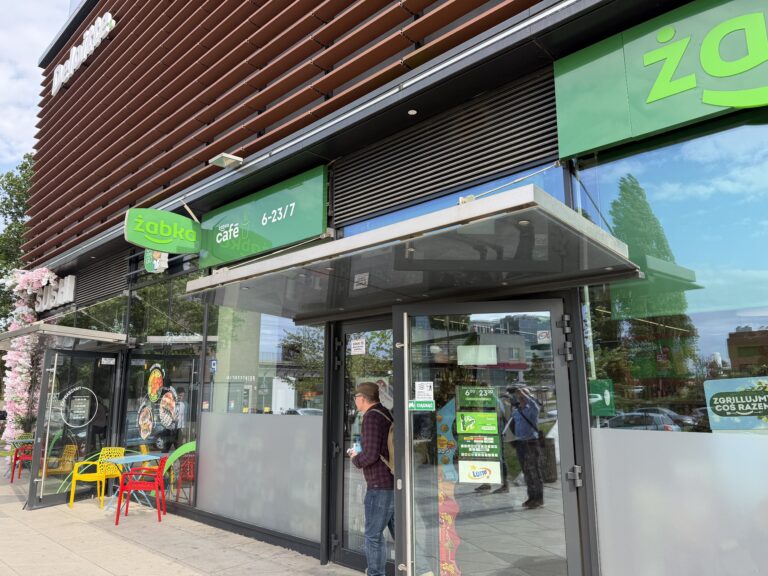
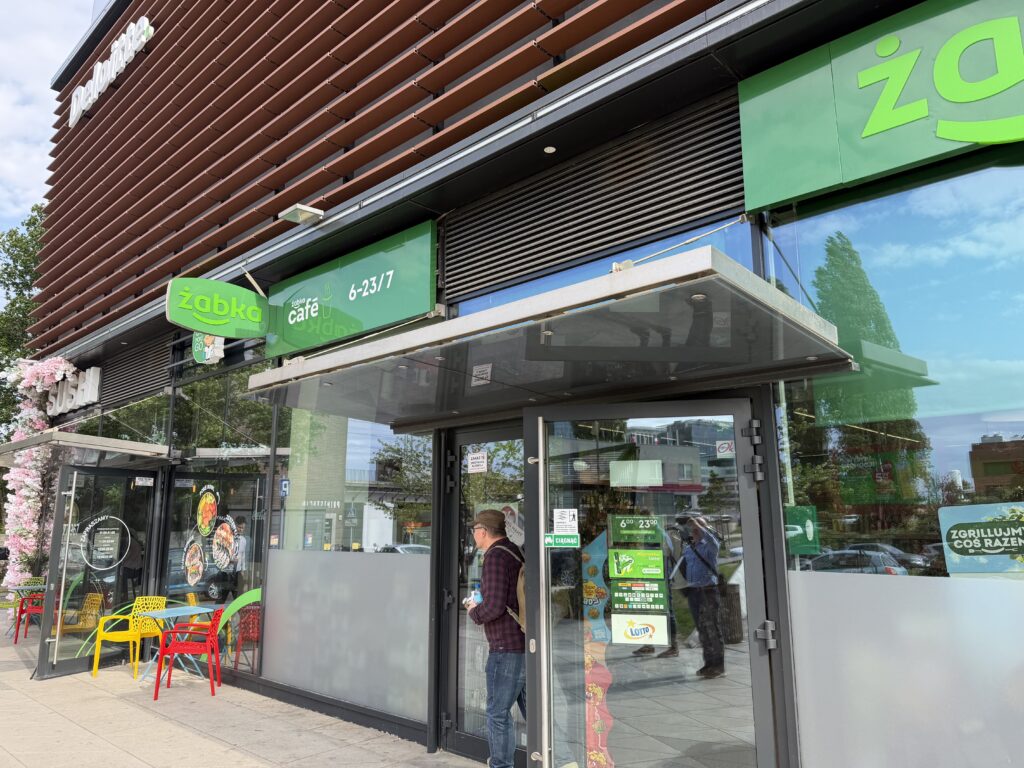
Żabka Group runs Poland’s largest convenience-store network – roughly 12,750 outlets across Poland and Romania at the end of Q1 2026, almost entirely franchised, complemented by a growing digital ecosystem of meal delivery, eGrocery and unmanned “Nano” stores.
It listed on the Warsaw Stock Exchange in October 2024 in one of the largest Polish IPOs in a decade, backed by private equity firm CVC Capital Partners.
It’s currently worth somewhere around PLN 32–33 billion – up from roughly PLN 22.6 billion in mid-April.
How the money actually works
Żabka doesn’t run most of its own stores – it runs the system that franchisees pay to plug into.
Franchisees get site selection, supply chain, brand, and an increasingly capable digital layer (the Zappka app has around 10 million active users); Żabka takes a cut of sales plus fees, while keeping the capital-heavy real estate and logistics centralized.
That’s why the business scales with relatively modest capex intensity – capex ran at just 5.2 percent of sales to end customers (StEC) in 2025 – and why franchisee churn (7.8 percent, down from 10.5 percent in 2021) is one of the more useful health metrics analysts don’t talk about enough.
The growth engine has three moving parts: new store openings (over 1,300 targeted for 2026), like-for-like sales growth at existing stores, and what Zabka calls New Growth Engines – its Romanian expansion (204 Froo-branded stores, with a long-term target recently raised from 4,000 to 7,600 units) plus its digital businesses, Maczfit, Dietly, Jush! and Delio.
In Q1 2026, network expansion did 64 percent of the growth work, like-for-like did just 25 percent, and NGE did the rest.
That mix matters, and I’ll come back to it.
This is also the exact profile that makes Żabka interesting to a buyer like Seven & i. The Japanese retailer operates something like 86,000–87,000 stores globally but has barely 360 in Europe, confined to the Nordics.
Seven & i has been under pressure from investors since fending off Alimentation Couche-Tard’s takeover attempt, sold its supermarket business to Bain Capital to refocus on convenience, and has explicitly named Europe as a fourth pillar of growth.
Żabka gives it a dense, proven franchise network, a working digital layer, and a management team that’s already built the playbook – without having to build any of it from scratch.
On paper, the strategic logic is clean.
The number I watch most closely
Everyone’s watching the deal headlines. I’m watching like-for-like growth, and it just did something the market seems to be ignoring.
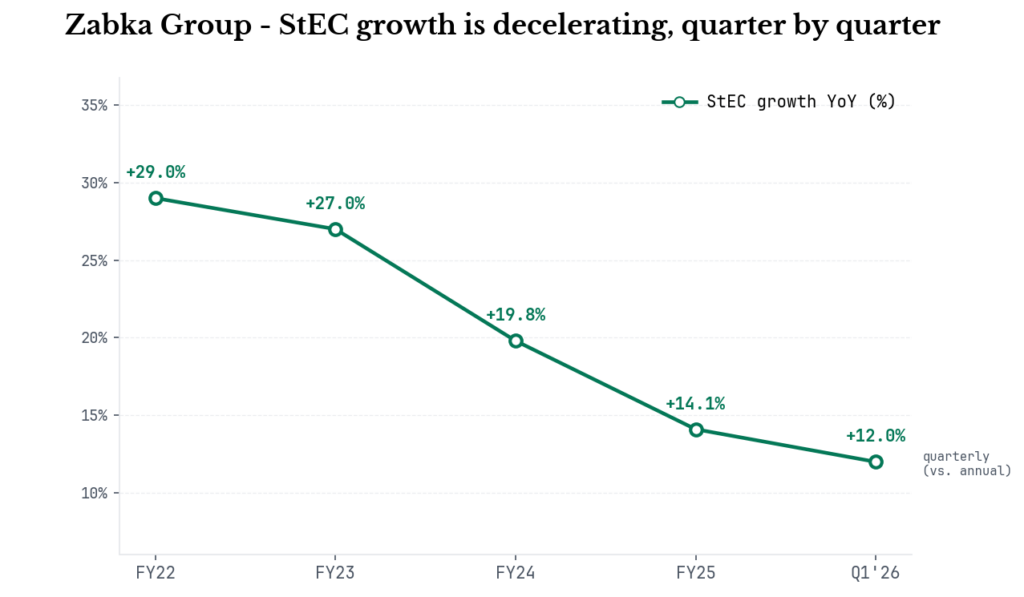
Żabka’s StEC (sales to end customers) growth has been decelerating for three straight years – from around 29 percent in 2022 down to 12 percent year-on-year in Q1 2026.
Some of that is simple math: you can’t compound off a bigger base forever. But the composition of that growth is what matters, and in Q1 2026, like-for-like sales – the purest read on whether existing stores are actually getting busier – grew just 3.2 percent, down from 6.0 percent a year earlier.
Management blames the coldest winter in over a decade and notes that in the warmer weeks of the quarter, like-for-like ran in the mid-to-high single digits, which is a specific, checkable claim rather than a vague excuse.
Here’s the catch: this is the second period in a row weather has been cited as the reason like-for-like undershot guidance. FY2025 also decelerated from 8.3 to 5.3 percent, partly attributed to weather-related headwinds. Once is a data point. Twice is a pattern worth testing – and the test comes on July 30, when Żabka reports H1 2026 results.
If the full first half doesn’t show a real bounce back toward the mid-to-high single-digit range management has guided for, the weather story stops being a sufficient explanation.
| Metric | Q1 2026 | Q1 2025 | Change |
|---|---|---|---|
| Revenue growth (StEC) | PLN 7,411m | PLN 6,618m | +12.0% YoY |
| Like-for-like (LfL) | +3.2% | +6.0% | -280 bps |
| Active stores (EoP) | 12,750 | 11,460 | +11.3% YoY |
| Free cash flow (FCF) | PLN 28m | ~PLN 92m (implied) | -69% YoY |
| Earnings (Adj. net result) | PLN -51m | PLN -77m | +33% (narrower loss) |
| Adj. EBITDA margin | 9.1% | 9.0% | +10 bps |
Adjusted EBITDA margin, meanwhile, keeps doing exactly what it’s supposed to: 9.1 percent in Q1 2026, up from 9.0 percent a year earlier, with net debt to adjusted EBITDA down to 1.1x from 1.6x.
That deleveraging was healthy enough that Żabka just declared its first-ever dividend – a modest PLN 0.53 per share, a roughly 1.5–2 percent yield at today’s inflated price, paid out July 31.
The chart above shows growth decelerating in a straight line for three years. What it doesn’t show is the last two weeks, where the stock re-rated on M&A speculation that has nothing to do with that trend. Żabka’s fundamentals didn’t change on July 16 – its ownership prospects did.
The market is pricing a deal, not a business
The dominant narrative right now is simple: Seven & i wants in, a deal is close, and the stock should keep re-rating toward global convenience-store multiples.
There’s a real structural argument for that – Żabka has historically traded at a 30–40 percent discount to peers like Alimentation Couche-Tard on EV/EBITDA, and a strategic buyer paying up to build a European platform isn’t an unreasonable scenario.
But the market is skipping a step. Żabka’s two largest shareholders – CVC’s Heket Topco vehicle (around 37.7 percent) and Partners Group’s PG Investment Company (10 percent) – are financial sponsors whose lock-up from a prior share sale expired in May, making them the obvious sellers.
If Seven & i buys enough of that stake to cross 33.33 percent of voting rights, Polish and Luxembourg securities rules could combine to trigger a mandatory tender offer to all remaining shareholders – which is exactly the scenario the market seems to be underwriting.
It’s also exactly the scenario that hasn’t happened yet. Consensus analyst price targets, still clustered around PLN 27, haven’t moved to reflect any of this – not because analysts disagree with the thesis, but because target prices don’t typically get revised on unconfirmed talks.
The risks you should actually worry about
The obvious risk is that talks collapse. Seven & i’s own statement is carefully hedged, and large cross-border retail acquisitions die in due diligence more often than headlines suggest.
If that happens, I’d expect a fast reversion toward the pre-rumor level around PLN 28–29, not a gentle drift – that’s a 10–15 percent air pocket from here with no earnings event required to trigger it.
The second risk is structural, not headline-driven: if like-for-like growth doesn’t recover in H1, the market may eventually have to separate the “Żabka is a great operator” thesis from the “Żabka deserves a re-rating” thesis, and re-price the stock on fundamentals that no longer support today’s multiple even without a deal falling through.
The third is closer to a technicality but matters for anyone buying today specifically for the takeover premium: even if a deal happens, there’s no guarantee it crosses the mandatory-offer threshold.
Seven & i could structure a stake purchase that stays below 33.33 percent of votes, in which case existing minority shareholders may never see the premium currently baked into the share price.
Watch the like-for like and the potential deal closely
I think Żabka is a genuinely good business trading at a price that currently has very little to do with being a genuinely good business.
The operational story – franchise scale, improving margins, deleveraging, a first dividend – is real and intact. But the last 20 percent of the share price move is a bet on a transaction that isn’t signed, at a premium level that isn’t confirmed, with a regulatory trigger that isn’t guaranteed.
For that to keep working, either the deal needs to close at a price above today’s market, or the fundamentals need to catch up to a valuation they haven’t earned yet on their own.
Watch two dates: On Thursday, July 30, when H1 results will show whether like-for-like actually recovers, and whatever comes next from Seven & i or Zabka on deal terms.
This is a position for someone comfortable owning event-driven risk with a defined near-term catalyst – you’re underwriting a specific outcome (deal closes, triggers a mandatory offer, at a premium) rather than a steady compounding story.
It’s the wrong holding if you need your thesis to survive a “no deal” headline without flinching: that single sentence from Seven & i could cost you 10–15 percent before you can react.
Disclosure: At the time of publication, the author holds a position in the securities discussed in this article.