Klarna Turned Profitable – the Market Still Isn’t Sure It Believes It

Klarna Group plc, the Swedish-founded digital bank and buy-now-pay-later provider, trades on the NYSE at a market cap of roughly $7.5 to $7.7 billion as of early August 2026 — down sharply from its IPO-week high near $15 billion.
The stock has swung between $12.06 and $57.20 over the past year, a range wide enough to make most large-cap investors uncomfortable before they’ve read a single line of the income statement.
TL;DR
- Klarna is a global buy-now-pay-later network that’s trying to become a deposit-funded digital bank, not just a checkout button.
- Q1 2026 was the first quarter Klarna posted a positive reported operating profit, and it beat its own guidance range on every single metric — GMV, revenue, transaction margin, and adjusted operating profit.
- The real risk isn’t competition from Affirm or Afterpay — it’s that Klarna already missed its own transaction margin guidance once, in Q4 2025, and one clean quarter doesn’t erase that.
- Transaction Margin Dollars, the metric management itself says it manages the business to, grew 44 percent year-over-year to $389 million in Q1, after bottoming at 31 percent margin in Q3 2025.
- I think Klarna’s discount to Affirm is roughly the right size given a five-quarter track record with one guidance miss in it — not proof the stock is cheap, and not proof it’s a value trap either.
Here’s the number that should reframe how you think about this company: transaction margin dollars, the metric Klarna’s own management says it “manages to,” bottomed at a 31 percent margin in the third quarter of 2025 and climbed back to 38 percent by the first quarter of 2026.
That’s not a story about a BNPL (Buy Now Pay Later) app losing its edge.
That’s a story about a lending business absorbing upfront credit provisions on a fast-growing loan book before the interest income from those same loans has had time to accrue.
Whether you believe the recovery is durable or a one-quarter blip is, in my view, the entire debate about this stock right now.
Payments App or Bank — And Why That Distinction Matters
Klarna operates as a licensed digital bank headquartered in Stockholm, listed on the NYSE under the ticker KLAR.
It runs three consumer products stitched onto a two-sided network of merchants and shoppers: Pay in Full (an everyday debit-like product), Pay Later (an interest-free “charge card equivalent” for medium-sized purchases), and Fair Financing, a longer-duration, interest-bearing installment product that runs three to 48 months.
As of Q1 2026, the network spans 1.075 million connected merchants and 119 million active consumers.
The company’s own framing — “spend-centric, not lend-centric” — is worth taking seriously rather than dismissing as investor-relations language.
Pay Later still makes up 77 percent of gross merchandise volume and turns over more than ten times a year, with an average consumer balance of just $124.
That’s a fundamentally different risk profile than a revolving credit card balance averaging roughly $6,900 in the U.S. Klarna re-underwrites essentially every transaction rather than extending an open credit line, and the company points to a through-cycle provision rate of about 0.6 percent across two decades and more than half a trillion dollars originated.
The Business Model, In Plain Terms
Klarna makes money three ways: merchant fees on Pay Later transactions, interest income on Fair Financing loans, and — increasingly — gains on sale from selling receivables to institutional investors through forward-flow agreements.
That third piece matters more than it might sound. In Q1 2026 alone, Klarna offloaded $1.2 billion of Fair Financing receivables and booked a $57 million gain on sale from it.
This is a capital-light growth lever: it moves credit exposure off the balance sheet, accelerates revenue recognition, and frees up capacity to keep originating loans without raising new equity or debt.
The funding side is arguably the more interesting structural story. Ninety percent of Klarna’s funding comes from consumer deposits — $12.3 billion as of the end of Q1 2026 — mostly long-term fixed deposits concentrated in Europe.
That’s a real cost-of-capital advantage over non-bank BNPL competitors that have to fund receivables through securitization or credit facilities.
It also means Klarna’s growth is less exposed to the kind of funding-market stress that can strangle a pure-play lender overnight.
Distribution is expanding on the merchant side almost as fast as the network itself: Stripe and Nexi are live and ramping as default-on payment partners, with JPMorgan Payments and Worldpay both scheduled to go live sometime in 2026.
That’s a meaningful distribution unlock — Klarna doesn’t have to sell merchants one at a time if it’s the default option inside a payment processor’s stack.
Why Transaction Margin Dollars Is the Number That Tells the Real Story
Four metrics matter here, and they don’t all point the same direction if you only look at the headline growth rate.
Revenue grew 44 percent year-over-year to $1.012 billion in Q1 2026 — the fastest quarterly growth rate in the five quarters of data available.
Fair Financing is doing the heavy lifting: interest income rose 56 percent, and the segment’s GMV grew 138 percent year-over-year, now representing 12 percent of total volume.
Transaction Margin Dollars (TMD) is the number I watch most closely, because it’s the one Klarna’s own CFO explicitly frames as the metric the company manages the business to — not revenue, not GMV. TMD hit $389 million in Q1, up 44 percent year-over-year, but the path to get there wasn’t a straight line.
It bottomed at a 31 percent margin in Q3 2025 before recovering to 38 percent in Q1 2026.
That dip and recovery is the clearest evidence of what management calls “deferred value creation” — Fair Financing requires upfront credit provisions on new cohorts before the interest income from those loans has time to compound.
When growth accelerates faster than expected, margins get squeezed first and expand later.
Provision for credit losses ran at 0.55 percent of GMV in Q1 2026, essentially flat year-over-year (0.54 percent in Q1 2025) and down from 0.65 percent in Q4 2025.
That’s the credit-quality reassurance bulls point to — provisioning didn’t spiral even as Fair Financing volume nearly doubled.
Average revenue per active consumer (ARPAC) rose 10 percent year-over-year to $32, evidence that Klarna is squeezing more value out of its existing 119 million users rather than relying purely on new-user growth to carry the top line.
| Metric | Value | Context |
|---|---|---|
| Revenue (Q1 2026) | $1,012m | +44% YoY, +36% like-for-like |
| Transaction Margin Dollars | $389m | +44% YoY; margin recovered from 31% (Q3’25) to 38% (Q1’26) |
| Adjusted operating profit | $68m | vs. $3m in Q1 2025 – a $65m swing |
| Provision for credit losses | 0.55% of GMV | Flat YoY (0.54%), down from 0.65% in Q4’25 |
| Active consumers | 119m | +21% YoY; ARPAC +10% YoY to $32 |
What the Chart Isn’t Telling You About the Margin Recovery
The transaction margin dollar chart looks, at first glance, like a clean recovery story: a dip in Q3 2025, then three straight quarters of acceleration into Q1 2026.
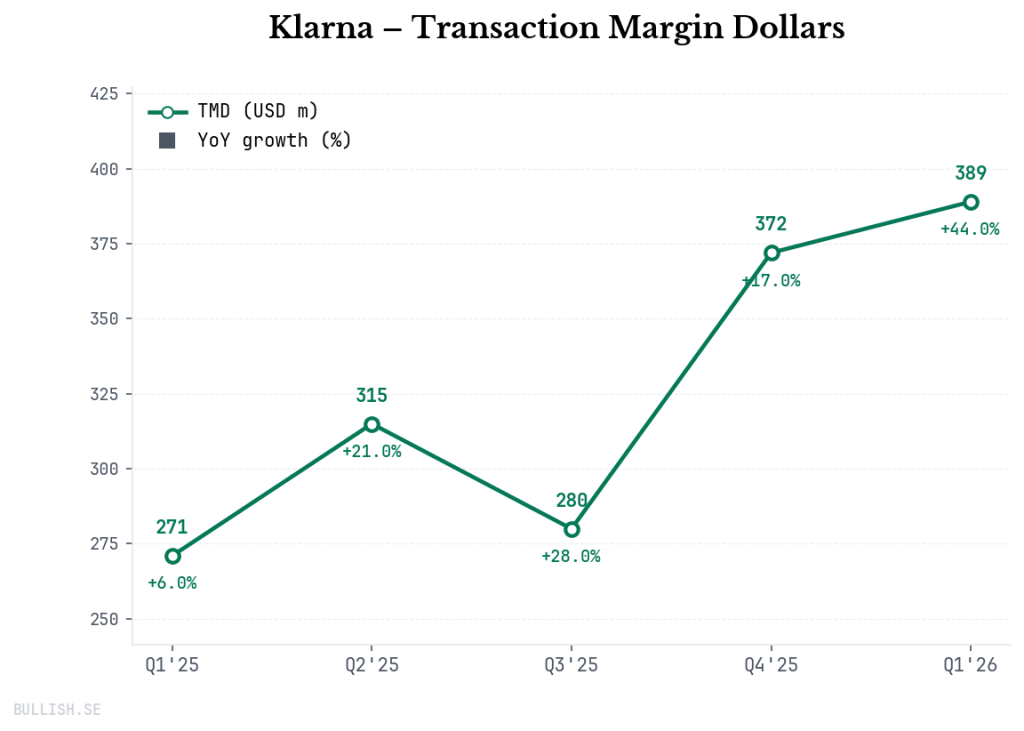
What the line doesn’t show is that this recovery happened at the same time Klarna’s stock fell from a post-IPO high near $57 to a low of $12.06 in March 2026 — a roughly 79 percent peak-to-trough decline.
The operating business and the stock price were, for a stretch, moving in almost opposite directions.
That’s not necessarily irrational; a lot of that decline predates the Q1 2026 beat and likely reflects the market digesting the Q4 2025 guidance miss along with broader fintech multiple compression.
But it does mean the current ~$20 share price already has some of the Q1 recovery priced in, even after a violent round trip.
The Market Has Already Priced In the Easy Comparison
The consensus narrative on Klarna right now is roughly: “the BNPL pioneer that finally turned profitable, trading at a steep discount to Affirm because it’s newer to the public markets and still working out the kinks.”
That’s directionally true, and it’s also the easy read — which is exactly why I’d push on it a little.
Affirm and Klarna posted broadly similar year-over-year growth in their most recent quarters, yet Klarna trades at roughly $7.5 billion versus Affirm’s $24–26 billion, a discount far wider than growth-rate parity alone would explain.
Some of that gap is legitimate: Affirm has posted multiple profitable quarters in a row, while Klarna has posted exactly one.
Some of it is technical — Klarna’s five-month-old public trading history and 2.08 beta make it a harder position to hold through a drawdown for a lot of institutional mandates, regardless of the underlying fundamentals.
But the part of the gap I think is underappreciated is structural: Klarna’s 90 percent deposit-funded balance sheet is a genuine cost-of-capital advantage that neither Affirm nor Afterpay can replicate without becoming a bank themselves.
The market is pricing Klarna like a scrappy fintech still proving itself. The funding model says it’s closer to a bank that happens to look like a fintech at checkout.
The One Risk Analysts Keep Underweighting
The obvious risk list for Klarna is competitive: Affirm has the Shopify relationship, Block has folded Afterpay directly into Cash App’s 59 million monthly active users, and PayPal is pushing its own pay-later product through sheer distribution scale.
Those are real, and worth watching, but they’re also the risks every BNPL earnings call already spends five minutes on.
The risk I’d actually worry about is guidance credibility.
In Q4 2025, Klarna’s own CFO wrote that transaction margin dollars “came in at $372 million, below our $390-400 million guidance,” attributing the miss to banking-service adoption growing faster than expected.
Fair enough — Fair Financing GMV growth genuinely did accelerate to 165 percent year-over-year that quarter, so the explanation is at least consistent with the data.
But then Q1 2026 beat the top end of its own guided range on every metric, including adjusted operating profit, which came in at $68 million against a guided ceiling of $35 million — essentially double.
That’s not a company dialing in its forecasting; that’s a company whose guidance band has been wrong in both directions within two consecutive quarters.
If Q2 2026, due August 18, produces a third data point that’s just as far off in either direction, the market should start discounting Klarna’s forward guidance the way it does with genuinely unpredictable early-stage growth names — which would be a real re-rating risk, not a one-quarter story.
The second risk worth naming: credit provisions in Fair Financing grew 37 percent year-over-year in Q1 2026, slightly outpacing the 41 percent growth in transaction margin dollars before provisions.
It’s a small gap today. If it widens as the loan book scales into a slower macro environment, the margin recovery this article is built around could reverse.
Where I Land
Klarna’s Q1 2026 was, by any reasonable reading, a genuinely good quarter — the kind of broad-based beat that would normally do a lot to rebuild credibility after a guidance miss.
I think the underlying business is more structurally sound than its stock chart suggests: a deposit-funded balance sheet, a re-underwriting model with a two-decade loss-rate track record, and a transaction margin that’s recovering roughly on the trajectory management laid out.
What I’m not willing to do yet is call the guidance miss in Q4 2025 an aberration, because one clean beat afterward doesn’t erase it — it just leaves the sample size at two data points instead of one.
What would change my mind in either direction: a second consecutive beat against Q2 2026 guidance would meaningfully raise my confidence that Q4’s miss was noise rather than signal.
A second miss — especially one accompanied by rising delinquency in the U.S. Fair Financing cohorts — would tell me the margin recovery story in this article was a favorable quarter dressed up as a trend.
Either way, August 18 tells you more about this stock than the last five months of price action did.
This is a stock for the investor comfortable underwriting execution risk on a young public company with a genuinely differentiated funding model — not for anyone who needs a multi-quarter track record before they can trust management’s own numbers.
If Klarna delivers two more clean quarters against its guidance, the valuation gap to Affirm becomes a much harder case to defend.
If it doesn’t, the discount you’re seeing today is the market being right, not early.
| Field | Value |
|---|---|
| Stock(s) | Klarna Group plc |
| Ticker | KLAR |
| Exchange / List | New York Stock Exchange (NYSE) |
| Sector | Fintech / Digital banking – buy-now-pay-later |
| Share price | ~$20.13–20.26 (Aug 4–7, 2026) |
| Market cap | ~$7.5–7.7 billion |
| Dividend | No |
| Next report | August 18, 2026 (Q2 2026) |
Disclosure: At the time of publication, the author does not hold a position in the securities discussed in this article.