Scandic’s Balance Sheet Looks Bulletproof – Its Margins Tell a Different Story

For six weeks this spring, hotel workers across Norway walked off the job.
Scandic runs 82 hotels there — its second-largest market — and by management’s own estimate, the strike knocked roughly SEK 100 million off top-line revenue, hitting 52 percent of Scandic’s Norwegian hotels versus an estimated 30 percent or less at competitors.
TL;DR
- Scandic is a leveraged-to-occupancy hotel operator that leases nearly all of its 324 hotels on revenue-linked rent, deliberately trading fixed-cost risk for margin volatility.
- The 2030 plan targets roughly 10,000 new rooms (half under the asset-light Scandic Go brand) plus 30-40 new franchise hotels, with the Dalata acquisition (56 hotels, Ireland/UK) as a complement rather than a departure from that plan.
- Country-level margins diverge sharply: Norway (15.7 percent, FY2025) and Sweden (14.8 percent) are strong, Other Europe is solid at 12.8 percent, and Finland is the clear outlier at 9.8 percent – briefly negative in Q1 2026.
- The business is heavily seasonal: Q3 carried a 17.1 percent margin in 2025 versus just 2.2 percent in Q1, which is why the trailing-twelve-month figure is the cleanest lens on the underlying trend.
- Adjusted EBITDA margin has fallen for four straight years (13.2 percent to 10.9 percent), missing management’s own target for 2025, though Q2 2026 improved year-on-year and pulled the TTM figure back up to 11.1 percent.
- My take: hold, not buy. Three things would change my mind – proof the margin target is achievable, a clean Dalata close, and Finland turning from a drag into a merely weak market.
And yet when the strike ended in late May, the company’s Norwegian operating margin had barely moved: 17.6 percent versus 16.4 percent a year earlier, actually up — and Scandic says it gained market share through the disruption.
That’s either a remarkable piece of business-model engineering, or evidence that the real story at Scandic is happening somewhere quieter — in a set of numbers that have been drifting the wrong way for four straight years, unnoticed because none of them individually looks like a crisis.
Nine Countries, One Balance Sheet Nobody’s Worried About
Scandic Hotels Group (SHOT.ST, Nasdaq Stockholm Large Cap) runs 324 hotels and roughly 68,500 rooms across nine countries, mostly in the Nordics.
It trades around SEK 80, a market cap of roughly SEK 17.4 billion, and it just told the market that its underlying profitability shrank for the fourth year running — at the same time as it walked into the largest acquisition in its history.
Sell-side coverage from Jefferies, UBS, Morgan Stanley and DNB Carnegie clusters around a consensus target of SEK 95.6, essentially slightly above where the stock already sits.
| Broker | Rating | Target Price |
|---|---|---|
| UBS | Buy | SEK 103 |
| DNB Carnegie | Buy | SEK 108 |
| Morgan Stanley | Underweight | SEK 74 |
| Jefferies | Hold | SEK 95 |
Why Scandic Would Rather Not Own Its Hotels
Scandic doesn’t own most of what it operates. It leases the buildings, and critically, the majority of those leases are tied to revenue — rent goes up when the rooms fill, and comes down when they don’t.
That single structural choice is most of the investment case. It’s why the Norwegian strike didn’t show up in the P&L: fewer guests meant less rent owed, not just less revenue earned, and the Norwegian employers’ association compensated the company on top of that.
Three brands cover three price points:
- Scandic (mid-market)
- Scandic Go (economy)
- Signature Collection (premium)
Since November 2025 Scandic has also been running Dalata Hotel Group’s 56 hotels in Ireland and the UK under a management contract, ahead of a formal acquisition expected to close in the second half of 2026.
Scandic is being paid roughly 4 percent of Dalata’s hotel revenue to run someone else’s business before it owns it — a genuinely clever way to have the integration generating cash before it’s generating risk.
The 2030 Plan: 10,000 Rooms, Half Asset-Light
None of this happens in isolation.
In February 2025, Scandic used a Capital Markets Day to lay out a growth plan through 2030: roughly 10,000 new rooms, about half of them under the asset-light Scandic Go brand, plus 30 to 40 new franchise hotels in markets where Scandic currently has no presence.

Franchise expansion is about as close to free optionality as a hotel operator gets — Scandic collects a fee and a brand footprint without leasing a single building.
Layered on top is a partnership with SAS aimed at capturing more of the corporate and loyalty traveler base, plus a new booking platform designed to lift ancillary revenue by selling add-ons like breakfast separately rather than bundling them in.
Management has been explicit that Dalata is a complement to this plan rather than a departure from it — the same goal, a larger and more geographically diversified hotel platform, just accelerated via M&A rather than pure organic build-out.
The capital allocation framework behind all of it is straightforward: fund growth, pay a steady dividend, and use buybacks opportunistically — exactly what a balance sheet carrying almost no net debt is built to support.
The Margin Line Nobody’s Talking About
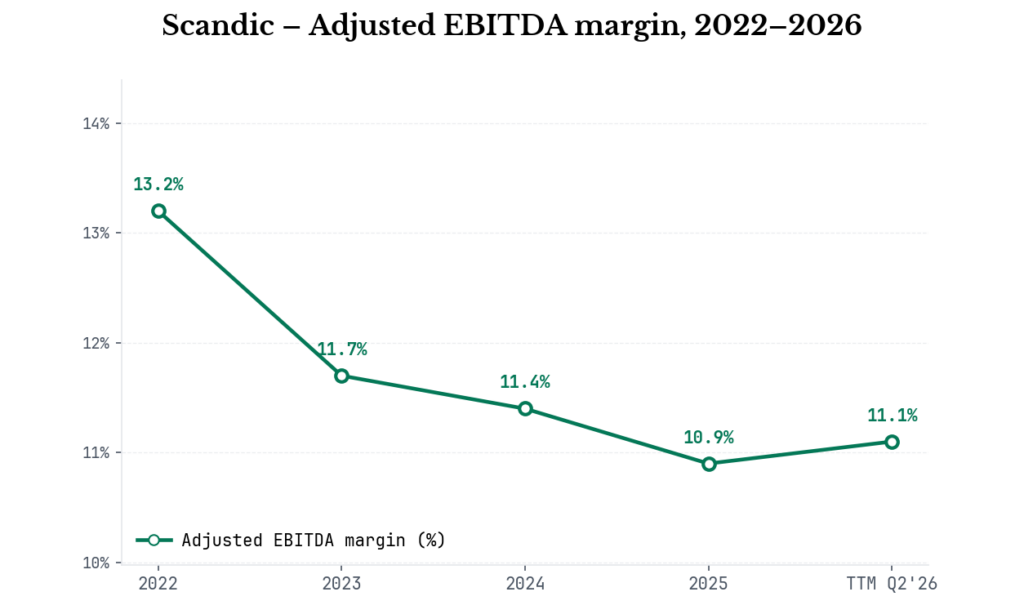
Here’s the number that matters more than anything in the last two quarterly releases: adjusted EBITDA margin has fallen every year since 2022, from 13.2 percent to 11.7 percent to 11.4 percent to 10.9 percent in 2025 — missing management’s own target of at least 11 percent for the year.
Organic growth told the same story: 3.9 percent against a stated target of at least 5 percent. Both misses, in the same year, from a management team that otherwise executes cleanly.
Contrast that with the balance sheet. Net debt against adjusted EBITDA fell from 1.1x in 2022 to essentially zero — 0.0x — by the end of 2025, and sat at just 0.1x at mid-2026.
That’s an unusually clean capital structure for a hospitality operator heading into a major acquisition, and it’s the reason Scandic could absorb Dalata without touching the dividend.
The fee income from managing Dalata’s hotels ahead of closing added SEK 116 million to adjusted EBITDA in the first half of 2026 alone — a genuinely underappreciated piece of deal structuring that de-risks the largest capital allocation decision in the company’s history before a single euro of purchase price has changed hands.
Break the margin trend down by country and the picture sharpens. Norway (15.7 percent full-year 2025 margin) and Sweden (14.8 percent) are performing well by any standard, and Other Europe, boosted by the Dalata fee income, comes in at 12.8 percent.
Finland is the outlier by a wide margin: 9.8 percent for full-year 2025, and by the first quarter of 2026 the segment had actually gone slightly negative on an adjusted EBITDA basis, before a modest recovery to 5.5 percent in the second quarter.
| Country/segment | Net sales H1 2026 (SEK m) | Adjusted EBITDA margin H1 2026 (H1 2025) | RevPAR H1 2026 |
|---|---|---|---|
| Sweden | 3,379 (+7.2%) | 12.6% (10.9%) | SEK 762 (+5.7%) |
| Norway | 3,106 (+4.0%) | 14.1% (13.8%) | SEK 825 (+2.1%) |
| Finland | 2,037 (-7.1%) | 2.7% (7.5%) | SEK 636 (-6.1%) |
| Other Europe | 2,164 (+7.8%) | 12.4% (9.6%) | SEK 912 (-0.8%) |
Three of Scandic’s four markets are performing in line with or ahead of the group average. One of them is dragging the entire consolidated number down.
The number I watch most closely is the trailing-twelve-month adjusted EBITDA margin, because it’s the one line that tells you whether the recent improvement is a real inflection or a seasonal blip inside a longer decline.
Q2 2026 alone came in at 13.3 percent, up from 12.5 percent a year earlier — enough to pull the TTM figure back to 11.1 percent from the 2025 full-year low of 10.9 percent.
| Metric | Q2 2026 | Q2 2025 | H1 2026 | H1 2025 | ||
|---|---|---|---|---|---|---|
| Net sales (SEK m) | 5,998 | 5,795 | +3.5% | 10,687 | 10,341 | +3.3% |
| Organic growth | +1.2% | +2.7% | ||||
| Adjusted EBITDA (SEK m) | 796 | 723 | +10.1% | 901 | 824 | +9.3% |
| Adjusted EBITDA margin | 13.3% | 12.5% | +0.8pp | 8.4% | 8.0% | +0.4pp |
| Operating profit (SEK m) | 899 | 816 | +10.2% | 1,111 | 1,010 | +10.0% |
| Net profit (SEK m) | 350 | 268 | +30.6% | 155 | 51 | +204% |
| Earnings per share (SEK) | 1.63 | 1.25 | +30.4% | 0.72 | 0.25 | +188% |
| RevPAR (SEK) | 882 | 879 | +0.3% | 774 | 765 | +1.1% |
| Occupancy (OCC) | 65.6% | 65.9% | -0.3pp | 60.7% | 60.6% | +0.1pp |
| Free cash flow (SEK m) | 532 | 709 | -25.0% | 59 | 29 | +103% |
| Net debt/adjusted EBITDA (LTM) | 0.1x | 0.3x | 0.1x | 0.3x |
Why Q1 Always Looks Ugly — and Why That’s Not the Real Story
Scandic’s business is heavily seasonal, and the gap is larger than most investors probably assume. Q3 — peak summer — carried a 17.1 percent adjusted EBITDA margin in 2025.
Q1 carried 2.2 percent, essentially break-even, weighed down by low business travel, Easter timing and the Christmas and New Year lull that management flags every year as the structurally weakest stretch.
Management also confirms the current growth is overwhelmingly leisure-led, with corporate demand merely stable — a mix that tilts naturally toward the summer quarter.
That means judging the business off any single quarter, or comparing half-year results to full-year results, is close to meaningless without adjusting for which quarters are in the sample.
It’s also why the trailing-twelve-month margin — covering all four seasons exactly once — is the cleanest lens available, and why the chart below is built on that basis rather than calendar-year or half-year snapshots.
Plot the margin from 2022 through the current trailing twelve months and the shape is unambiguous: four years down, then a small uptick.
The uptick is real — Q2 2026’s margin genuinely beat the prior year — but it follows a decline steep enough that one quarter doesn’t undo it.
Why the Street Isn’t Worried — and Where That Might Be Too Comfortable
The dominant narrative around Scandic right now is straightforward: well-capitalized Nordic consolidator, buying growth in Ireland and the UK on favorable terms, funded by a balance sheet that gives it options most hotel operators don’t have.
Analyst sentiment reflects that reading. That’s not a mispriced stock in either direction; it’s a market that’s largely settled on “fine.”
Where I think that comfort gets a little too easy is in treating balance-sheet strength and operating strength as the same thing.
A net debt ratio of 0.0x is genuinely impressive, but it’s also partly a function of restrained capital spending and a buyback program management itself has framed as on hold until the Dalata integration is complete, not a permanent feature.
The market has priced Scandic as if the deleveraging is the operating story.
It’s closer to a precondition for the real test, which is whether Dalata integrates cleanly and whether the margin line actually turns — neither of which is confirmed yet.
Three Things That Would Actually Move the Stock
First, prove the 11-percent margin target is achievable, not aspirational.
Scandic missed its own 2025 targets on both organic growth (3.9 percent against a 5-percent goal) and adjusted EBITDA margin (10.9 percent against 11 percent).
A second consecutive quarter of year-on-year margin improvement — which Q3 2026 would provide, if it happens — would be the first real evidence since 2022 that these targets are within reach rather than restated every year.
Second, land Dalata cleanly.
This is the largest transaction in company history, and management’s own risk disclosure states plainly that the integration “could take longer, be more costly or create more complexity than expected.”
A carve-out that closes on schedule in the second half of 2026, with clearly communicated synergies and a clean first full quarter of consolidated Irish and UK results, would do more for the stock than almost anything else on this list, because it would validate the entire acquisition thesis at once.
Third, stop Finland from being a drag rather than just a weak market. A segment that briefly went negative on adjusted EBITDA in the first quarter of 2026 isn’t merely underperforming — it’s actively subtracting from group profitability while Norway, Sweden and Other Europe all outperform.
Management now points to something more specific than hope: several large meeting and event bookings are already on the books for the second half, the renovation of Scandic’s largest Helsinki hotel finishes at year-end, and the comparison base normalizes after a weak prior-year quarter.
On the back of that, the company is effectively guiding to Finnish margins back above 13 percent in the second half, in line with last year.
That’s a real, checkable number — and given that Scandic already had to walk back one Finland recovery timeline earlier this year, it’s also the one guidance figure in this report I’d hold management to most literally.
None of these are exotic asks. They’re probably the same three things management would list themselves if asked what needs to go right.
I think Scandic is a hold, not a sell, precisely because the balance sheet buys time for all three to play out — but time isn’t the same as certainty, and the stock likely won’t re-rate meaningfully until at least one of them shows up in a quarterly print rather than in guidance.
What I’m watching next is Q3, due November 10.
Disclosure: At the time of publication, the author does not hold a position in the securities discussed in this article.