The Eleven-Times Discount: What the Market Thinks It Knows About Novo Nordisk

Here’s the thing about Novo Nordisk that gets lost in the noise around its stock price: the company didn’t stumble into the obesity boom.
It manufactured it, patiently, over a decade of semaglutide research that most of the market ignored until Wegovy’s launch turned it into a household name.
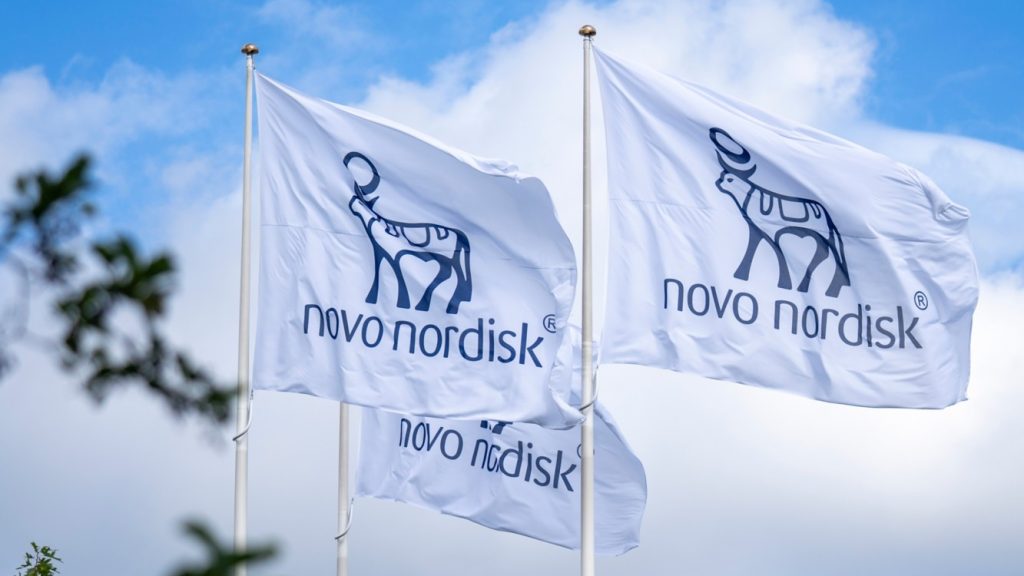
That’s the backdrop worth holding onto, because the last eighteen months look, on the surface, like a company falling apart.
The share price is down 48 percent since the end of 2024.
Its most important pipeline asset has now failed to hit its primary target twice. And yet the company just raised its full-year guidance for the second consecutive quarter.
Both things are true at once, and untangling them is the whole game.
TL;DR
- Novo Nordisk is the company that turned a decades-old diabetes franchise into the world’s dominant obesity-drug business, built on semaglutide — sold as Ozempic and Wegovy.
- The strongest argument for the stock right now is arithmetic: it trades at roughly a quarter of Eli Lilly’s earnings multiple while still leading new-patient starts in the US obesity market.
- The risk that actually matters isn’t pricing pressure — it’s that CagriSema, the drug meant to be Novo’s answer to Lilly’s tirzepatide, has now disappointed twice in nine months.
- Adjusted sales grew just 2 percent at constant exchange rates in the first half of 2026, against 25 to 35 percent annual growth as recently as 2022 to 2024, while gross margin compressed by nearly 4 percentage points year-on-year.
- My take: this isn’t a value trap, but it isn’t a clean buy either — the discount to Lilly won’t close until CagriSema proves it can compete, and betting on that outcome is a clinical call dressed up as a valuation call.
Semaglutide, Sold Two Ways
Novo Nordisk’s business is deceptively simple to describe and genuinely hard to replicate: one molecule, semaglutide, sold under different brand names into two related but distinct markets.
Ozempic and Rybelsus treat type 2 diabetes; Wegovy, in injectable and – since January 2026 – pill form, treats obesity.
Both work by mimicking GLP-1, a gut hormone that regulates appetite and blood sugar.
The commercial insight was recognizing, earlier than most competitors, that the same drug class could anchor two enormous and overlapping markets.
What’s easy to miss is how much of the current story runs through distribution, not chemistry.
Wegovy’s oral pill crossed 5 million prescriptions in the US since its January launch and reached roughly 265,000 weekly prescriptions by mid-July — the strongest GLP-1 volume launch the market has seen.
That’s not just a new SKU; it’s a wedge into a self-pay and telehealth channel (NovoCare Pharmacy, plus partnerships with Ro, WeightWatchers, and LifeMD) that operates almost entirely outside the traditional insurance-and-PBM system Novo has spent decades navigating.
It’s a genuinely different go-to-market motion, running in parallel with the legacy insured channel.
The strategic pivot underneath all of this is pricing, not product.
Novo signed a “Most Favoured Nations” agreement with the US administration in late 2025, and starting January 2027 it will cut US list prices on Wegovy and Ozempic by roughly 50 and 35 percent, respectively.
That’s the trade the company is making explicitly: give up price to defend volume and expand access, on the bet that GLP-1 penetration in a market of roughly a billion people living with obesity still has enormous room to run.
The Numbers That Matter
Start with the one that should worry anyone modeling Novo Nordisk off its historical growth rate: adjusted sales grew just 2 percent at constant exchange rates in the first half of 2026.
That’s not a rounding error — it’s a cliff relative to the 25 to 35 percent annual growth the company posted every year from 2022 through 2024.
Reported growth looks far better (18 percent in H1), but that’s almost entirely a function of a one-off DKK 26.8 billion reversal of US rebate provisions booked in the first quarter — strip that out, and the underlying business is barely expanding.
Margin tells a similar story.
Adjusted gross margin fell to 79.3 percent in H1 2026 from 83.1 percent a year earlier, hit by lower realized US prices, roughly DKK 3 billion in one-off manufacturing right-sizing costs, and currency drag.
That’s a nearly four-point compression in two quarters for a company whose margin structure used to be a point of near-total stability.
Then there’s the segment detail that doesn’t show up in the headline figures: Wegovy injectable sales in the US fell 22 percent at constant currency in the second quarter, even as the Wegovy pill grew from nothing.
That’s not simply substitution — a meaningful chunk of that injectable decline is lower realized pricing, which means Novo is trading price for volume inside its own franchise before the 2027 list-price cut has even landed. If that’s happening now, the margin math for 2027 and beyond deserves real scrutiny, not just a guidance-range assumption.
Against that backdrop, the guidance revision looks less impressive than the headline suggests. Novo raised full-year 2026 adjusted sales and operating profit growth guidance from a range of -4 percent to -12 percent (as of May) to 0 percent to -6 percent (as of August) — both in constant currency.
That’s a real improvement, but the starting point was already a guidance cut from the growth rates investors got used to.
The number I watch most closely is that adjusted sales growth figure, because it’s the cleanest read on whether the deceleration from 31 percent (2023) to 6 percent (2025) has actually found a floor, or is still searching for one.
| Metric | Value | Context |
|---|---|---|
| Adjusted sales growth, H1 2026 (CER) | +2% | Down from 25-35% annual growth in 2022-2024 |
| Adjusted gross margin, H1 2026 | 79.3% | Down from 83.1% in H1 2025 |
| Free cash flow, H1 2026 | DKK 55.3bn | Up 44% year-on-year |
| Net debt / EBITDA (TTM, estimated) | ~0.5x | Net cash position since 2024 |
| P/E (TTM, adjusted, estimated) | ~11x | Versus roughly 40x for Eli Lilly |
What the Chart Isn’t Telling You About the Growth Story
The five-year sales chart looks, at a glance, like a company still compounding nicely — the bars keep climbing, right through 2025.
That’s true in absolute terms and almost beside the point.
What matters is the second line: growth of 31 percent in 2023, 25 percent in 2024, and just 6 percent in 2025, with the underlying (adjusted) figure for H1 2026 running at only 2 percent.
The share price has already done the work of pricing that deceleration in — it’s why the stock sits near DKK 292 today versus DKK 624 at the end of 2024, a nearly 50 percent drawdown that happened before this week’s earnings reaction even started.
What the chart can’t show is whether 2025’s growth rate is the new cruising altitude or still a plane in descent; that’s a forward-looking question the historical numbers simply can’t answer on their own.
The Market Is Pricing Novo as a Value Stock, Not a Growth Stock — And That’s the Real Story
Here’s what’s actually interesting: the market isn’t debating whether Novo Nordisk is a good business anymore. It’s debating whether it’s still a growth business at all.
At roughly 11 times trailing adjusted earnings, Novo trades closer to how the market prices a mature, ex-growth pharma name than a company still leading the fastest-growing drug category in the industry. Eli Lilly, its closest competitor, trades at nearly four times that multiple.
Three ways to read that gap.
One: the market is right, and Novo’s growth rate really has structurally reset to low single digits, in which case an 11x multiple is arguably fair, maybe even generous given the pipeline risk.
Two: the market is overcorrecting for a string of bad clinical headlines and underpricing a business that still controls the largest obesity franchise on earth.
Three — and this is the version I find most persuasive — the market isn’t mispricing Novo so much as refusing to underwrite CagriSema until it sees real data, and that refusal is entirely rational given the trial history.
The multiple gap isn’t really about Ozempic or Wegovy. It’s a referendum on whether Novo’s next act will work.
The One Risk That Isn’t About Pricing
Everyone talks about US drug pricing when discussing Novo Nordisk, and it’s a legitimate risk — the 2027 list-price cuts of up to 50 percent will compress margin, full stop.
But it’s not the risk that should keep an investor up at night, because it’s known, guided, and already partially reflected in the stock.
The risk that matters more is CagriSema, the combination amylin-GLP-1 drug Novo needs to keep pace with Eli Lilly’s tirzepatide.
It missed non-inferiority against tirzepatide in the REDEFINE 4 head-to-head trial back in February.
Then, on the same day as this quarter’s earnings release, a lower-dose readout from REDEFINE 9 landed with less punch than hoped, contributing to a same-day share price decline.
Two disappointments in six months, on the company’s single most important next-generation asset, is a pattern, not an anomaly.
The second risk worth naming is more unusual: a federal judge in New Jersey recently allowed part of a shareholder lawsuit over CagriSema’s trial communications to proceed, rejecting Novo’s motion to dismiss.
The case centers on whether the company misrepresented how consistent its Phase 3 dosing protocol was with earlier trials.
Regardless of how the litigation resolves, it signals that some investors believe management’s messaging around CagriSema outran the actual data — a reputational risk that compounds the clinical one.
The third: Wegovy injectable’s 22 percent CER sales decline in the US this quarter suggests Novo is already trading price for volume within its own portfolio, before the bigger 2027 price cut even arrives.
If that internal cannibalization dynamic worsens, the 2027 guidance assumptions look optimistic rather than conservative.
The Verdict
I don’t think Novo Nordisk is broken, and I don’t think it’s cheap in any simple sense either — it’s a business the market has correctly repriced for a genuinely slower growth phase, with real optionality attached if the next pipeline generation delivers.
What would change my mind in either direction is specific: a clean, competitive FDA outcome for CagriSema in the second half of 2026 would go a long way toward closing the Lilly valuation gap; a third consecutive disappointment, whether in the FDA review or the REDEFINE 11 readout expected in the first half of 2027, would suggest the market’s skepticism is earned rather than excessive.
Between now and then, I’m watching gross margin trajectory in Q3 as the cleanest read on whether the pricing story is stabilizing or still deteriorating.
This is a stock for the patient GLP-1 believer who can tolerate binary clinical risk and doesn’t need the growth story to work on this year’s timeline — the cash flow and balance sheet buy you time to wait for CagriSema to either prove itself or get replaced by something else in the pipeline.
It’s the wrong stock if you’re underwriting a re-rating on valuation alone: an 11x multiple can go lower, and has, before it goes higher, if the next data readout disappoints again.
| Field | Value |
|---|---|
| Stock(s) | Novo Nordisk B |
| Ticker | NOVO-B.CO (Nasdaq Copenhagen) / NVO (NYSE, ADR) |
| Exchange / List | Nasdaq Copenhagen, Large Cap; ADR on NYSE |
| Sector | Pharmaceuticals – diabetes, obesity, rare disease |
| Share price | DKK 291.7 (Aug 5, 2026) |
| Market cap | ~DKK 1,290bn / ~USD 198bn (estimated) |
| Dividend | Yes – DKK 11.70/share for 2025 (yield ~4.0% on current price) |
| Next report | Nov 4, 2026 |
Disclosure: At the time of publication, the author does not hold a position in the securities discussed in this article.