Investor Just Had Its Best Quarter in Years — And That’s the Problem

Investor just returned 15 percent in a single quarter.
If that were the whole story, this would be a short, enthusiastic article.
It isn’t the whole story, and that’s what makes this one worth writing.

TL;DR
- Investor is Sweden’s largest holding company — Wallenberg-family capital spread across listed industrials, wholly-owned private subsidiaries, and a direct stake in EQT.
- Adjusted net asset value rose 9 percent in the second quarter and total shareholder return hit 15 percent, powered almost entirely by one stock: ABB.
- The real risk isn’t the portfolio — it’s the price. The stock now trades close to net asset value, which historically has been exactly the gap that made owning it worthwhile.
- Leverage sits at just 1.9 percent, Patricia Industries grew organically 7 percent, and EQT’s listed stake fell 15 percent for the half — three very different stories under one ticker.
- My take: hold, not buy. This is a quality compounder priced like one right now, and I’d rather wait for the discount to come back than pay up for a quarter that was mostly ABB.
Three Sleeves, One Balance Sheet
Investor is Stockholm’s answer to a diversified holding company done at scale: three sleeves of capital, one balance sheet.
The largest sleeve, roughly three-quarters of total assets, sits in listed minority stakes — ABB, Atlas Copco, AstraZeneca, SEB, Saab, and others.
The second, Patricia Industries, is where Investor actually owns and runs things: Mölnlycke, Nova Biomedical, Laborie, Sarnova, Permobil, a cluster of wholly- or majority-owned medtech and mobility companies.
The third and smallest sleeve is a direct bet on EQT — both the listed shares and a slice of its private equity fund family.
Three different risk profiles, three different return drivers, reported once a quarter as a single net asset value per share.
That structure is the whole investment case, and it’s also why a single quarter’s headline number can be misleading.
Adjusted NAV per share rose from 367 kronor at the end of March to 397 kronor at the end of June — an 8 percent jump in three months.
Total shareholder return for the half hit 23 percent, more than double the SIXRX index’s 8 percent. On paper, that’s about as good as a holding company quarter gets.
| # | Holding | Business Area | Share of Total Assets |
|---|---|---|---|
| 1 | ABB | Listed Companies | 23% |
| 2 | Atlas Copco | Listed Companies | 13% |
| 3 | AstraZeneca | Listed Companies | 8% |
| 4 | SEB | Listed Companies | 7% |
| 5 | Saab | Listed Companies | 7% |
| 6 | Mölnlycke | Patricia Industries | 6% |
| 7 | Sobi | Listed Companies | 5% |
| 8 | Epiroc | Listed Companies | 4% |
| 9 | EQT | Investments in EQT | 4% |
| 10 | Nasdaq | Listed Companies | 4% |
| 11 | Wärtsilä | Listed Companies | 3% |
| 12 | EQT fund investments | Investments in EQT | 3% |
| 13 | Ericsson | Listed Companies | 3% |
| 14 | Nova Biomedical | Patricia Industries | 3% |
| 15 | Laborie | Patricia Industries | 2% |
Dig one layer down and it stops looking like broad-based strength and starts looking like ABB.
The listed portfolio returned 20 percent for the half, and ABB alone contributed nearly 99,000 million kronor of that value increase — more than half the total gain across all thirteen listed names combined.
Atlas Copco, Sobi and Epiroc chipped in real contributions too, but Saab actually lost money for shareholders in the quarter, down 17.5 percent.
This wasn’t a rising tide. It was one very large wave.
Where Investor Actually Makes Money, And Where It Doesn’t
The listed sleeve is straightforward: Investor collects dividends and rides share prices in companies it doesn’t control day-to-day but does sit on the board of.
Patricia Industries is the opposite model — full or majority ownership, active operational involvement, and a portfolio built through both organic investment and acquisition.
Laborie’s January purchase of the JADA system, a postpartum hemorrhage device, cost roughly 3.9 billion kronor and was funded with cash and debt.
Vectura consolidated its remaining 50 percent stake in a Gothenburg health-innovation property complex the same quarter.
This is a holding company that still does deals, not just collects dividends.
And the underlying businesses are doing fine.
Across the nine major Patricia Industries subsidiaries, organic growth in the second quarter came in at 7 percent, with Laborie up 13 percent and BraunAbility up 12 percent.
Adjusted EBITA across the group grew 16 percent. That’s a genuinely strong operating quarter for a portfolio of mid-sized industrial and medtech businesses.
Here’s the disconnect: Patricia Industries’ total return to Investor’s NAV was negative 3 percent for the quarter, despite that growth.
The reason is valuation multiples, not operations. Investor marks these private businesses to market using EV/EBITDA multiples borrowed from comparable listed peers, and those multiples compressed across the board — Sarnova’s estimated value fell by 3.2 billion kronor on multiple contraction alone, Permobil by nearly 2 billion.
Strong businesses, shrinking price tags. That’s a real phenomenon, and it’s the opposite of what happened in the listed sleeve.
Why 14.6x Is The Number I’m Actually Watching
Everyone will look at the 9 percent NAV growth headline.
The number I watch most closely is the 14.6x weighted-average EV/EBITDA multiple Investor applied to its major Patricia Industries subsidiaries at quarter-end — because that multiple, not another strong ABB print, is what would actually re-rate this half of the portfolio.
Right now you have a segment growing organic sales at 7 percent and adjusted EBITA at 16 percent, being valued at a lower multiple than three months ago.
If that multiple simply holds steady next quarter while the growth continues, Patricia Industries’ contribution to NAV should turn meaningfully positive on operations alone — no help needed from the stock market.
If it keeps compressing, growth won’t be enough to offset it, the way it wasn’t this quarter.
The EQT sleeve tells a third story entirely.
EQT’s share price fell hard enough that Investor’s investments in EQT lost 15 percent of their value over the half, with the AB stake down 25 percent in total shareholder return.
Investor kept buying anyway — another 1.7 billion kronor into EQT shares during H1 — which either signals conviction at lower prices or stubbornness, depending on your view of private equity valuations right now.
What The Total-Return Chart Is Actually Telling You
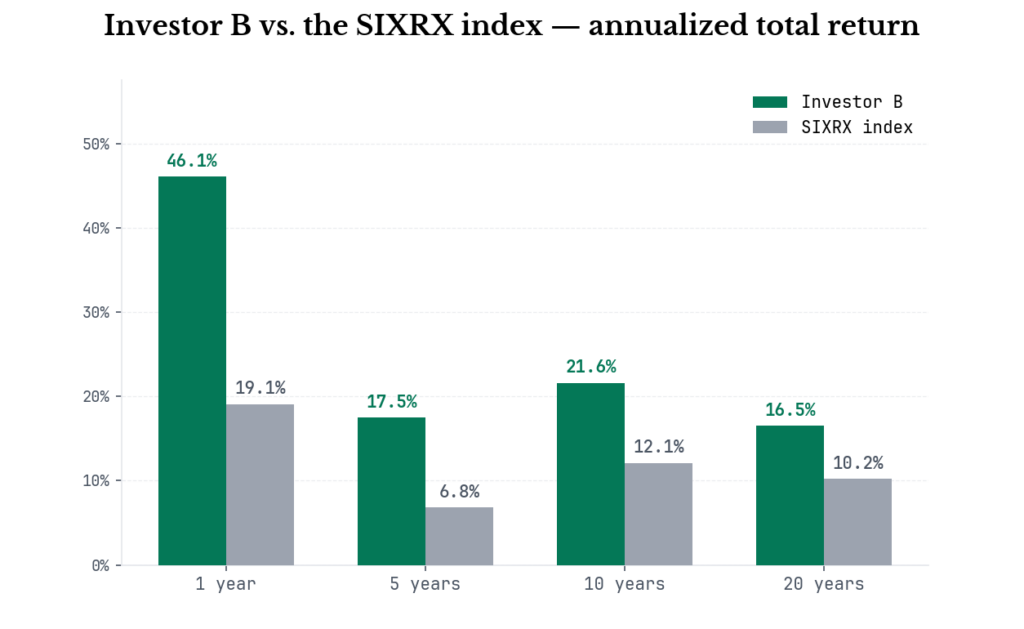
Look past the quarter and the pattern holds across every time horizon Investor discloses: 46.1 percent over one year against 19.1 percent for SIXRX, 17.5 percent annualized over five years against 6.8 percent, and the gap barely narrows even at the twenty-year mark.
This isn’t a lucky quarter compounding into a lucky chart — it’s structural, decades-long outperformance from a business model built on patient, controlling ownership.
The temptation is to read that chart as proof you should own this stock at any price.
I’d read it differently: that record was built by people who bought Investor at a discount to its assets, not at a premium to them.
The chart argues for the strategy. It doesn’t argue for today’s entry price.
What The Market Is Pricing In, And What It’s Missing
The market’s read on Investor right now is straightforward: strong quarter, strong balance sheet, buy the momentum.
What that read glosses over is concentration.
A market that’s rewarding Investor mostly for owning ABB is implicitly betting that ABB’s run continues, because ABB alone now represents 23 percent of Investor’s total assets.
That’s not diversification risk in the abstract — it’s a specific, measurable dependency on a single industrial stock staying hot.
The market is also treating the near-vanishing NAV discount as a non-event, when historically that discount has been the entire reason value investors bothered with holding companies instead of buying the underlying stocks directly.
The Risks Worth Actually Worrying About
First, multiple contraction in Patricia Industries could simply continue.
If EV/EBITDA multiples for medtech and mobility peers keep sliding into next quarter, even double-digit organic growth won’t be enough to move NAV, the way it wasn’t this quarter — and that’s a real, ongoing dynamic, not a one-off.
Second, EQT could keep falling.
A further leg down in EQT’s share price, on top of the 25 percent already lost this half, would turn a currently small drag into a more meaningful one, especially since Investor is actively adding to the position rather than trimming it.
Third, and least likely but not impossible: a sharp reversal in ABB specifically would hit Investor disproportionately hard given how much of this quarter’s gain came from that single name.
It’s not the base case, but it’s the scenario that would expose just how much of the “strong quarter” narrative was really a one-stock story.
Where I Land
Investor remains one of the highest-quality holding companies in Europe — disciplined leverage at 1.9 percent, an AA-/Aa3 credit rating, and a management team that keeps buying good businesses at sensible prices rather than chasing headlines.
None of that is in question. What’s changed is the price you’re being asked to pay for it: a stock trading close to its own net asset value, with the quarter’s gains concentrated in one holding and a private-markets segment that’s currently being valued down despite growing up.
I’d want to see either the discount widen back out or the Patricia Industries multiple stabilize before adding here.
Watch the Q3 report on October 16 for early signs of both.
This is a stock for the patient compounder who’s comfortable owning three different businesses through one ticker and can tolerate a quarter or two of multiple noise in the private portfolio.
It’s the wrong pick if you’re buying because ABB just had a great quarter — that’s a reason to own ABB, not a reason to pay full price for the holding company sitting on top of it.
Disclosure: At the time of publication, the author holds a position in the securities discussed in this article.